
Can You Save the World’s Oceans? by Chris S. '11
Who, me? Yes, you.
“It has been calculated that if no accident prevented the hatching of the eggs and each egg reached maturity, it would take only three years to fill the sea so that you could walk across the Atlantic dryshod on the backs of cod.”
–Alexander Dumas, 1873, on the prolific reproduction of cod.
“Our data highlight the societal consequences of an ongoing erosion of diversity that appears to be accelerating on a global scale. This trend is of serious concern because it projects the global collapse of all taxa currently fished by the mid-21st century (in the year 2048).”
–“Impacts of Biodiversity Loss on Ocean Ecosystem Services”, Science, November 3, 2006.
“”At this point 29 percent of fish and seafood species have collapsed — that is, their catch has declined by 90 percent. It is a very clear trend, and it is accelerating. If the long-term trend continues, all fish and seafood species are projected to collapse within my lifetime — by 2048.
“It looks grim and the projection of the trend into the future looks even grimmer. But it’s not too late to turn this around. It can be done, but it must be done soon. We need a shift from single species management to ecosystem management. It just requires a big chunk of political will to do it.”
–Professor Boris Worm, Dalhousie University, Halifax, Canada. Author of “Impacts of Biodiversity.”
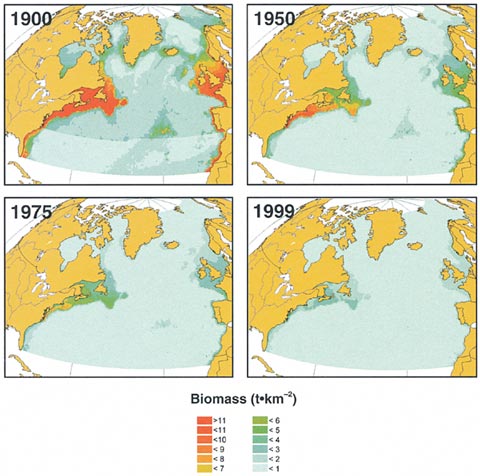
Note the dramatic decrease in biomass (living matter – like fish, shrimp, scallops, krill…etc.) in the Atlantic Ocean from 1900 to 1999. Just in 99 years…
Source: Daniel Pauly and Jay Maclean, In a Perfect Ocean, 2003.
—
What happened to the world between Duma’s 1873 optimistic observation and Worm’s grim prediction, just 133 years later? What can we do about this issue, before it’s too late?
This is precisely the topic of Mission 2011.
Mission, or otherwise known in the course catalog as 12.000 – Solving Complex Problems, is a freshman-only, 9-unit course that is geared towards exactly what the course title says – solving complex problems. Each year, the freshman of each Mission class tackle one aspect of great complexity (2010 – New Orleans Reconstruction, 2009 – Tsunamis in the Pacific Basin, 2008 – Galapagos Island Preservation Management), and devise a plan of addressing this “complex problem.”
Freshmen taking this course are exempt from the 54-unit credit limit (our’s is 57). Mission also takes the place of a freshman seminar
Over the first semester, freshmen in Mission examine in-depth the issue presented that year, starting from conducting extensive research on the topic. The topic is subdivided into sub-topics that discuss the issue on a closer level (a few examples of this year’s groups were: International Cooperation, Aquaculture, and Environmental Change) through a variety of research methods – books, journals, Internet, and real-life interviews, just to name a few. At the end, the consolidation of research takes place, and the group as a whole begins to devise a “plan of change” to the central issue. This solution is also generally drafted by different students who had begun to specialize in different subtopics. At the end, these drafted solutions are compiled together to form the “master solution.”
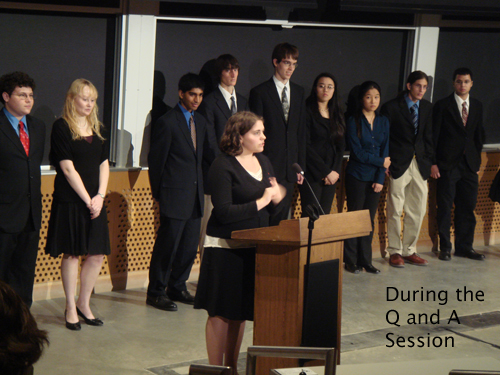
At the end, a website is created, summarizing the efforts of the class. A verbal final presentation is also given to a panel of specialists (for this year – biologists, oceanic researchers, fishing representatives), with a live Q-and-A to follow. The Q-and-A session is one of the most interesting moments of the class, as students are now asked to demonstrate their mastery of the content and the logic of their solution live, in front of a group of knowledgeable experts. You can see the recorded final presentation (which took place on December 4) here.
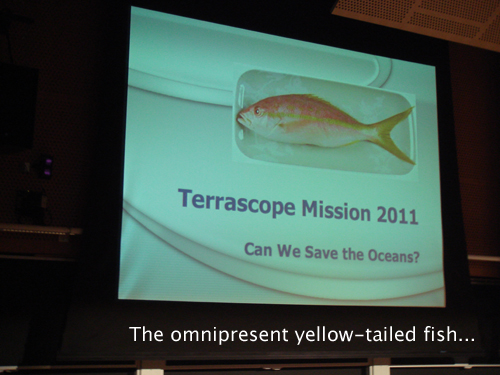
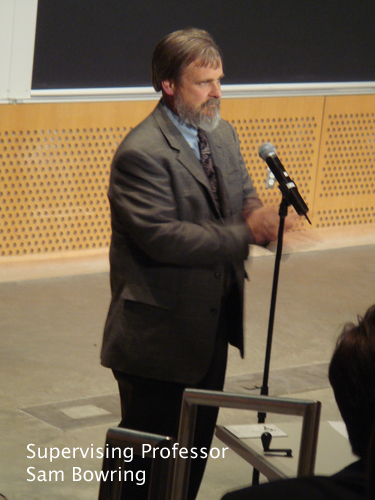
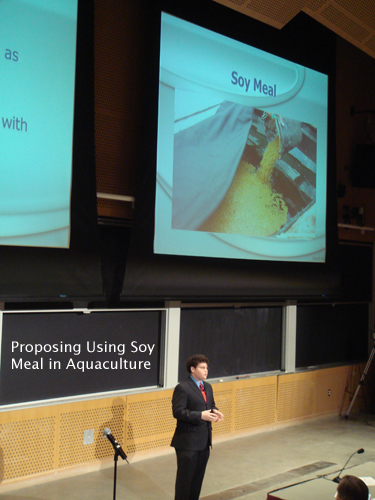
I think one of the most impressive things about a class like Missions is the focus on formulating a solution to a real-life, continually evolving problem. In the beginning, the answer seems simple and straightforward – “the fish are dying? why don’t we just eat less fish?” After reading through thousands of pages of books, journals, and .pdfs and pulling several all-nighters, the answer doesn’t seem so simple anymore. There are so many levels to the same problem – environmental concerns, politics, social issues, finance, international cooperation…and I’m just scratching the surface.
What Missions make you realize is that each “complex problem” in the world entails an immensely web of interconnected issues. Quickly, you begin to realize that “eating less fish” simply isn’t a sufficient solution to many island nations, who depend almost exclusively on fish as a source of protein. Also, what about countries like Japan, which had been traditionally and culturally dependent on fish? (think sushi…). Also, how do you implement your solutions after you formulate them? How are you going to increase public awareness of the issue (how many people do you know that know 70% of commercial marine fish species is being fished at ecologically unsafe levels?). How are you going to get the legislators in Washington DC to care? How are you going to ask countries in the UN to cooperate on a treaty addressing overfishing?
Welcome to Solving Complex Problems.
The workload is overwhelming at times, and there often seems be no end to the research – but I came out of the class knowing more about subject of overfishing than I ever did for the last eighteen years of my life – and it really gave me an appreciation of the pressing need to educate the public and increase awareness about the subject. With the projected world population to break 9 billion within my lifetime (in 2050), this is something that I need to care about, now.
Mens et Manus. Mind and Hand. Now you know the facts, what are you gonna do?
Cool! This class sounds like a must-take. Research skills, debates, etc., all fun and useful.
Also, you’re missing a an end-paren in the 4th paragraph (beginning “Freshmen taking this course are exempt…”)
I love the fact that MIT has classes such as these – where students can actually apply what they learn to the real world. This is one of the reasons why I want to go to MIT.
Speaking of which, I’m dying to receive some mail from MIT…
so, what is the solutiom?
*solution
lol. “Mens and Manus”.
I don’t think “and” is Latin.
“Mens ET Manus” :D
Yay for being vegetarian!
@Z Wang
I completely agree with you! THIS is one of the major reasons MIT is a league apart from the “rest” of the colleges in the world.
@Chris
Thanks for this informative post Chris. I wonder what you would say if I suggested something like this as an activity to my school principal? I mean, at a smaller scale of course. Maybe, addressing a national problem or something, limiting our scope to our country? Your opinion would be helpful..
Keep posting!
ya politics are so complicated. living in DC, i get it all first hand. my school is littered with the kids of senators and house reps.
I think our leaders should come from a sound intellectual basis. otherwise they can just be good orators with good connections. that’s not what our nation needs. vote ron paul
+when do the early action applicants hear back from MIT?
Thanks SO much for describing this class in detail; this is something I’ll definitely consider if I make it to MIT. It sounds intense, but as you said, anything that results in a wealth of knowledge is probably worth it at the end.
I have a question though: what happens after your final presentation? Do you start working on implementation after the semester is over?
early decision letters when will you come?!!!!!!!
@ Shantini and Bunny:
Dang it, I knew someone would catch my typographical mistakes. I wrote this entry when I was running out the door and I KNEW I made some mistakes. ahaha
What’s the release date for the EA admissions?!
Thanks for describing this course in detail – the complexity of layers and multiple perspectives and problems inherent in complex problems requires the gifts and talents of many. The interrelatedness in complex problems makes them interesting and compelling. Thanks for sharing – I enjoyed viewing the course and hearing more about it.
Hm, you’re right, eating less fish isn’t a solution when there are countries like Japon who can’t live without it. I think the most difficult part would be to make DC care…
This project is so cool, I hope next year’s will be great too (and I hope I’ll be participating ^^’).
Going on the website right now !
Shamarah:
I think that this the main reason for going to MIT. Otherwise, if they weren’t up for intense classes, people would just go to some in-state tech school or something.
The problem is that not enough people care; in my opinion, apathy is one of the main causes of all the major problems that we have.
@Z Wang
i agree completely! that’s exactly what i said on an app for another school that asked “what is a significant problem faced by the world today”… that school, however, isn’t nearly as awesome as MIT.
first!
My best friend is in this class! Yay, Claire! Go save the fishies!
I watched the film Empty Oceans, Empty Nets some time ago which gives some perspective on the collapse of fisheries worldwide some time ago. Even though it was a depressing film it was well done. Also, it painted a hopeful picture to some extent by showing a well managed Alaska Halibut fishery.
Many people are not aware of this problem but also I feel like a lot of people know about it and do not care. As long as the demand for overfished fish such as blue fin tuna continues there is little that can be done. People need to learn more about this issue. Marine sanctuaries help but migratory fish are still in danger as soon as they leave the sanctuary.
Wow.. I wonder what the topic for 2012 will be?
Uh.. I just noticed that Laser wondered the same thing… oh well. Great minds think alike.
Wow, this looks intense. I wonder what next year’s topic would be (a hopeful ’12er, as well).
Hi :D
I’m applying to MIT this year, and I’m also from Taichung!!! yay
I’m going to have my interview today, and just wanna say that your advices on the interview are really helpful!! I feel less nervous now~
Wow! If I end up at MIT, I’m definitely taking this class! This just sounds really really awesome :D
MIT can-is-will forever change the world. What an awesome class that freshmen can jump right into it. It sounds intense on top of the regular freshman courseload, but what is Pass/No record for, right?
MIT in 2012! Maybe…
Hyun Jin, perhaps great minds also go to MIT together? 12/15!
MIT is GOD
Z Wang,
I agree too; that’s definitely why I want to go there, and I hope my question didn’t make it sound like I thought the class was too “intense,” because that definitely wasn’t my intention :D
I’d still really like to know what happens after the final presentation though!