
Let’s do a puzzle. by Anna H. '14
Ready to flex some cranial muscle?
You’re sitting in your living room, one eye on an Agatha Christie novel and one eye on the TV, which is showing the latest episode of Sherlock (you have trained your oculomotor nerves for this purpose.) It’s boring, because you’ve already solved both mysteries and are tired of watching Monsieur Poirot and Mr. Holmes bumble about. Suddenly, you realize that there is one puzzle in the universe you have not solved: what did Anna H. ’14, the MIT blogger, spend the weekend of Jan 13-15 doing?
Your instinct is to do what you ALWAYS do when you have a question about her MIT life (right? right?) – e-mail her! You’re in the mood for a more challenging/illegal way of doing things, though, so you get one of your minions to steal her computer. First stop: gmail calendar, obviously. You get to the site, and but the blinding array of colors with which she color-codes everything makes it impossible to extract any useful information. You give up, and decide to look at her browser history instead; after all, this is winter on a 21st century MIT campus, so chances are that whatever she spent her weekend doing involved the Internet.
You start with Friday Jan 13. Gmail. Gmail. Gmail. Facebook. Gmail. Facebook. Gmail. Scroll scroll scroll. Gmail. NYTimes. NYTimes. xkcd. Facebook. Gmail. Your eyelids are beginning to droop when you reach 6:30pm – and things begin to get interesting.

You haven’t the faintest idea who those people are, or what that little red B icon means – but a quick glance down reveals that wheoever they are, they prompted Anna to start reading about saints.
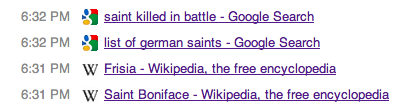
…and so on, and so on, until, FIVE AND A HALF HOURS LATER (she spent her ENTIRE FRIDAY EVENING reading about obscure saints?!)
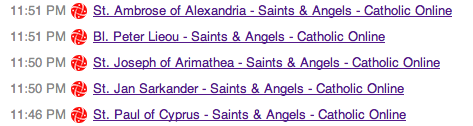
She didn’t just Google saint names.

She used incendiary WHAT as a WHAT?
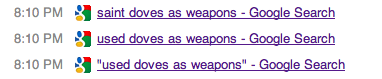
How alarming. And why on earth is she searching things in LATIN?

Your expertise with dead Romance languages tells you that this means “this day.”
Right around then, search terms involving festivals, holidays, and actions begin to appear (to your disappointment, incendiary doves do not make another appearance.)

You force yourself to concentrate on finding trends in the search history. You separate the search terms into two categories: those involving saints, and those involving festivals. You realize that towards the beginning of the evening, she showed more interest in descriptions of the festivals (ex. “festival climb on table, discus throwing day”) and descriptions of the saints (ex. “saint killed in battle”, “saint doves as weapons”) – but that, as the night progressed, her search terms became both more name-specific, and more date-specific (ex. “saint february 20”, “November 17 holiday, “saint nennocha june 4”, “January feast days”).
Aha! Feast days. Dates associated with saints. You realize that she is interested in finding out which feast day corresponds to a saint with a particular description (ex. “saint killed in battle”). She presumably started with a description of the saint, since those were her first search terms. Similarly, she started with descriptions of festivals and then ended with dates. Where do saint feast days and festival dates intersect? Well, both are…dates. Hac die. Could she be comparing dates? Matching up saints with festivals that happen to fall on their feast day?
And, if so, why would anyone spend their evening doing that?
The key lies in the page she visited about half an hour after her last saint- or festival-related search term.

You recognize that icon. It’s the MIT icon! And puzzles, well…Anna is an MIT student, after all. MIT kids like their puzzles. Could she be doing a puzzle? A puzzle about saints and dates and festivals? You keep scrolling and realize that, if this was the case, the saint/date/festival puzzle wasn’t the only one she tackled that weekend. Her browser history shows similar (though less lengthy) Google search fixations: the periodic table, three-word common expressions (ex. “little boy blue”, “take the loss”, “cold comfort farm”), Sherlock Holmes, suffixes, anagrams, frequencies of different letters in the English language, alkaline cleaning materials, stock tickers, South Indian chicken potato curry (South Indian chicken potato curry?!), something called “The Eye of Argon”*, children’s songs, children’s nursery rhymes.
*More on this shortly.
What kind of weird puzzle – or set of puzzles – would involve reading about South Indian chicken potato curry AND children’s nursey rhymes AND anagrams AND Sherlock Holmes AND cold comfort farms? Also, what kind of weird puzzle collection would involve running searches at these obscene hours –
From Friday “night” (if that’s still the right word for it):

From Saturday “night” (the search history tells you that this was a sleepless night):

From Sunday “night”:

Your immune system is trembling at the thought. Finally, one page in her browser history reveals the source of this weekend-long intellectual adventure:

MIT Mystery Hunt. An annual puzzle competition for some of the world’s most intense puzzle-solvers. Hunt is held over one weekend during IAP; alumni swarm back to campus in droves and students recruit friends from within and outside of MIT to join in the quest. This year, the hunt had a musicals theme (“Borbonicus and Bodley” are a spinoff of “Bialystock and Bloom”, from The Producers.) 33 teams representing hundreds of participants signed up, and devoted the weekend to performing all kinds of outrageous intellectual feats at the whims of the devious puzzle designers.
Below are some of those outrageous intellectual feats (such anecdotes are, I think, the only way to do some shred of justice to Mystery Hunt.)
One puzzle I worked on was called “Pirates of the Tyrrhenian” (see here) which presented a very suspicious-looking “loot list” (what the heck would someone do with 1400 apple pies?) and a map of the US that assigned each state a letter. Three of us worked on it together, and spent about twenty minutes playing with the numbers to figure out what they could possibly mean. At some point, one of my friends decided to try converting the numbers to Roman numerals. I’ll be frank: never in a bajillion years would I have tried that, because Roman numerals spit out useless-looking letters like X and L and M and C. The letters didn’t look useless to my friend, though, who somehow thought up the possibility that these could be stock tickers.
When you convert the number 1400 to Roman numerals, you get MCD. You know what you get when you look up the MCD stock ticker? McDonald’s. 1400 apple pies. McDonald’s. We screamed and high-fived and jumped around and rushed to look up all the rest of them; we found the state each corporation was based in, plotted them on the map, found the corresponding letters, and scrambled them to spell STOCKBROKER, which turned out to be the answer.
So. Awesome. How my friend figured that one out, I will never understand.
My favorite puzzle-ing experience by far was when the same group of us tackled “Argh” (take a look.) There were 31 short sound files, each following the same format: 1) a man speaks, not in words but in “hmm”s, 2) the man laughs, 3) a girl responds in English. We realized that we had to figure out what the guy was saying, based on his intonation and the friend’s response – however, this would be next to impossible with only that information. We therefore decided that he must be reading from some text available online, and set about trying to figure out what that could be. Why was he laughing? Was he making a joke?
In two different clips, the girl mentions a name: something that sounds like “Grigner”. We Googled it – no luck. Griggner? Grygner? Grignr? Breakthrough. Grignr is the main character in a text called “The Eye of Argon”: a famously terrible piece of prose, written by a teenager “who could usefully have been replaced by an infinite number of monkeys“* back in the 1970s. A little bit of research taught us that a popular game is to try and read out loud from “The Eye of Argon” without laughing (we tried – it’s next to impossible.) This explained the man’s laughter. The only remaining task was to comb through the story and, using the girl’s responses as guides, find the 31 passages. Combing through “The Eye of Argon” at 3am with two very sleep-deprived friends – I may never laugh so hard again. It was fantastic – and very cool to realize how easy it is to match a passage of text with particular intonation patterns.

*Source: http://www.ansible.co.uk/sfx/sfx043.html
By taking the first letter of the last word of each quote, we got a sentence, one word of which was BLANK. We found that sentence in “The Eye of Argon”, and the answer to the puzzle turned out to be the word corresponding to BLANK.
At this point, it was around 5:30am, so we decided to go back to French House to get some sleep. We had been hunting over at Random Hall, since Random and French House have a nice tradition of working together on one team. Campus was completely deserted – there were no bleary-eyed backpack-wielding college students scrambling to get to class on time, no late-night partyers, no cars or campus shuttle or birds. Just us late-night hunters, reveling in the adrenaline of solving puzzles. We held scarves over our faces to block the wind and admired Mars, which had risen up high and bright and red. One builds a lovely camaraderie from solving puzzles.
Actually, I shouldn’t say from solving puzzles. I should say from working on puzzles. You know that saints one? With the festivals and dates (and clues in Latin)? We spent something like seven hours working, and never actually solved it. At some point, we gave up and moved on, because we were tired of scouring the darkest corners of the Internet for the most obscure saints ever. This time, we bonded not through high fives and celebrations, but through a sort of shared angst (AHHH WHY DID I JUST SPENT SEVEN HOURS OF MY LIFE DOING THAT I NEVER WANT TO SEE ANOTHER SAINT-RELATED WEBSITE AGAIN.) Being able to enjoy the process regardless of the end result is a wonderful luxury; many teams (including ours) don’t actually aim to win, because the winning team earns the right to design the puzzles for the next year, and most people would rather solve than create.
So! Now you know what Anna the blogger spent Jan 13-15 doing. Congrats. Turn your problem-solving skills elsewhere (if you’re interested, here’s a link to this year’s puzzles) and return her computer before she notices and freaks the heck out.
Oh my _god_ the JFK puzzle. I tried to parse through all of them as airport codes, with the last being a two-letter code being SS, which is not an airport. This is Corsair’s IATA code. I was convinced that this was the correct answer, but no!
The letters just formed an arrow on the keyboard pointed at the (semi)colon button!
AAAHHHHH!!!!
(<3 Mystery Hunt)
So who makes these puzzles anyway?
@KP: The team that won the previous year’s hunt.
I love the Mystery Hunt so much! It was one of the things that got me interested in MIT and I spent my internship this summer researching it and writing a proposal for a similar event at another college.
I sure hope I get in so I can take part in it some day! Who doesn’t love a nice, healthy mix of trivia, puzzles, frustration, and sleep deprivation?!
Anna, I FEEL YOUR PAIN. I worked on that saints puzzle for most of Friday afternoon. The extraction was a bit of a letdown after all the work it took to find the saints. (Although St. Olga, the one who used incendiary doves, was incredibly cool to find out about.)
My team managed to screw up coming in second place, so I’ll be helping write next year’s hunt!
@Kamran: Only a handful require some knowledge of MIT: the ones that involve running around campus looking for particular items (and then finding the coin at the end of it all.) The vast majority are totally fair game for both MIT and non-MIT people though.
fantastic piece of writing, heads off
I Got my answer :D
I Wish I could participate in this event.( I am right now in the middle of admission process. :D )
I just reviewed the 2011 puzzles. Some of them I really didn’t understand such as Da Vinci’s Workshop and some other had references that should be known such as the one which was photos recreated from a comic book that you should have known that.
I have another question? Teams consist of how many players?
from don’t understanding i meant even with seeing the answer. :D
could you explain me how MITians understand what they should look for? for example in this one http://web.mit.edu/puzzle/www/11/puzzles/world1/photo_album/ how they understand that those are the names of the children of celebrities?

@Kamran: There is no set number of team members, and no upper limit to how many people can be on one team. For that reason, if a team really wants to win hunt, they usually put a lot to work into recruiting.
Re: the puzzle – figuring out the “trick” to a puzzle (thinking to look for the names of celebrities’ children) is one of the most challenging parts. It often involves throwing a bunch of search terms into Google and hoping to find some kind of relationship. For example, the whole stock ticker thing I mentioned – I would never have guessed that just by sitting around and thinking, but maybe eventually I would have Googled the Roman numeral along with the product name and seen a company pop up.
(That said, I’m no Mystery Hunt expert – this was my first time, and my answer to your question reflects my first impressions. That question would probably be better answered by someone with more experience.)
Oh, wow. I saw that one but didn’t attempt it. For those of you who don’t know, there was a puzzle called JFK SHAGS A SAD SLIM LASS…and that was it. You clicked on the page, and all you saw was the title. Daunting stuff.
I looked at some of the puzzles. They are really hard and challenging. I really enjoyed it. I just have a question :
doesn’t these puzzles need any MIT related information? I mean that can outsiders solve the puzzles or not?
@Kamran
in addition to what Anna said, there are patterns to how to go about starting many Mystery Hunt puzzles: for instance, you read the “flavor text” or text provided at the start of the puzzle (this year’s puzzles were rather sparse in flavor text, though), you click around and see if you get new information (did anyone do Blinkenlights?), you Google whatever is in the puzzle, you look through the source code for anything useful. If there are images, you might do a reverse image search; if there are videos, you might watch them all and try to identify them; if there’s a crossword, you try to solve it. Of course, any of these could be red herrings, but there are commonalities that make the starting points more obvious. The awesome thing is that as you go through the puzzle, all this random crap information you get thrown at you (hopefully) boils down into one word.
@Kamran
and also, sheer numbers can make a big difference, since it increases your chances of someone randomly knowing the answer to a puzzle, or having an epiphany. For instance, this year’s winning team, Manic Sages, was basically enormous. Some teams have alums, faculty, high school students, or other (generally) MIT-affiliated people that can bring in useful knowledge. There was one puzzle this year that required you to know the language Toki Pona, which was taught a few years ago during an IAP class at MIT (but hasn’t been recently), so having an alum on the team who might have taken that class would have helped.
that said, hacking your way through a puzzle (even if you don’t get the answer) is where all the fun is in Mystery Hunt anyway :D
… actually wait, that’s probably misinformation, I don’t think faculty are allowed… are they? Or they’re probably too busy… anyway, sorry for all the posts…
Hehe I just solved the “General Knowledge” puzzle after looking at it for just about half an hour!
I’ve always thought it would be really amazing for a film crew to do a documentary on the Hunt…both from the perspective at Film HQ and also that of the winning team. I’ve always wondered how it feels to solve all the metapuzzles and race to the coin location. :p
Hunt HQ…not Film HQ. :p
Hi,
Thank you all for your answers.
@ Anna : So we can categorize the puzzles into 2 categories: the ones that are logical and the ones that are more based on the creativity + Google (God bless Google ;D) this is what I wanted to be sure of.
@ Anon : I am really interested in puzzles and I used to play such games in our own language. and I can make very hard (but logical) puzzles. I really wish to enter MIT and win this competition only to be the one who is the puzzle creator.