
all the classes I didn’t take by Taylor L. '29
you seem pretty unsure for a girl so in love with her major
We are a week away from the point of no return: the Institute-wide Drop Date, where we choose either to abandon ship from our most hopeless classes and save our GPAs, or forever hold our peace. Unfortunately, I can’t participate in the festivities this year, or else I would drop below the full-time student credit limit and become a part-time student, so I’m going down with the ship.
I’ll briefly mention what I’m taking right now: 8.02,01 Physics II: Electricity and Magnetism 18.02,02 Multivariable Calculus CC.512,03 Organic Chemistry I, in my learning community Concourse 6.100B,04 honestly don't even know what this one is called but it's a bunch of computer science data processing and visualization and 21G.612,05 Russian II which, for a total of 57 units, should run me about 51.4 hours per week. I already dropped 21L.02406 Literature and Existentialism earlier in the semester because I had massively overextended myself. 07 I’m only mildly overextended now
But, it might also be worthwhile to tell you about what I didn’t take.
We have a super helpful scheduling website called Hydrant, which is typically how students decide which classes to take during registration. This is where I got the hours per week estimate from (it’s an average of the workload that past students have reported).
So, on Hydrant, this is what my current schedule looks like:
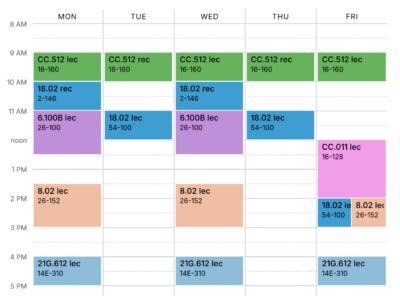
This is pretty nice, and I really like the big open blocks of free time.
What if I got rid of free time entirely? Here’s what my schedule could look like if I had Hermione’s Time Turner. It’s a casual 310 units (roughly 26 classes), for 416.4 hours a week. Miraculously, I’d only have to take five finals.
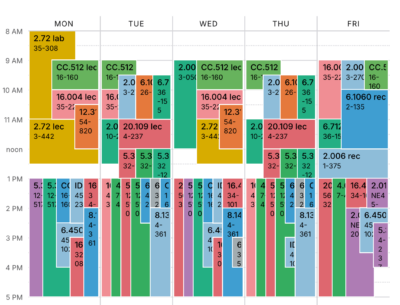
I wanted to add more classes, but after reaching around 250 units, it started taking five minutes to add each additional class, and it crashed my browser twice. I don’t think we’re meant to plan on taking over 400 hours weekly.
This makes sense, though: I only have 168 hours in my week, of which I’d like to spend 56 sleeping. How badly do I want to fill the remaining 112 hours to the brim?
Normally, I wouldn’t want that at all, but there’s a part of me that really wants to maximize each and every minute I have. I say this every year, but this year really has gone by faster than last year. It’s hard to believe that I first got to campus 7.5 months ago, and that in April of last year, I was still finishing out my senior year of high school. Things are exciting, and as a side effect, that means that they’re moving quickly.
When I was applying for my summer UROP research funding the other day, the website told me that, for the summer term, I would be considered a second-year, which I really didn’t appreciate. With the end of my freshman year looming, stuff like that does add a little urgency to my undergraduate experience. They’re already replacing us with new freshmen. We’re antiquated. I’m around 20% done with my whole undergrad now, and 20% rounds up to 50%, so it’s basically already over.
With my current 51.7 hours workload, that leaves about 60.3 hours throughout the week that don’t have to do classwork. If I wanted to be busy and doing something every second, I absolutely could. If I’m walking through the academic building at 9pm, there’s somehow something happening in a lot of the classrooms I pass. If you’ve ever seen those photos of a big apartment building at night, where you see a silhouette in each window doing something completely different from its neighbors, that’s what it can feel like.
There’s something that chemists call chemical space, which is the set of all possible molecules in all their different configurations—all those currently known and all those possible. I like to think about therapeutic drug discovery as the exploration of this space, instead of as the invention of new molecules from thin air. I also like to think of Hydrant as a chemical space. In the same way that molecules can exist theoretically even if they haven’t been synthesized yet, there are countless other paths through MIT than the one I’m on, even if nobody’s taken them yet.
There’s something really interesting about all of these possibilities unfolding out in front of you, and still ending up with only one of them. It’s like sculptors claiming that their statue lies inside a lump of marble, waiting to be carved out and released, or like electrons in their probability clouds, collapsing into discrete particles once observed, or maybe like the infinite monkeys, who, given infinite time, type out Shakespeare’s oeuvre on their keyboards.
It’s also a little disappointing that, to choose one path, you have to forsake the others. In manufacturing, there are additive and subtractive processes, where the final product is either assembled from smaller components, or reduced down into its final form from a larger shape, respectively. They both end at the same end result, but to me this comparison between building something up and breaking it down is sort of like a glass half empty/full situation. It just feels a little pessimistic that you have to get rid of so much to get to where you really want to be.
Like, if I’m looking at my day, what’s going on there? Am I saying “yes” to what I’ve chosen to do, or am I saying “no” to everything else? If I’m thinking about that nightmarish Hydrant schedule above, it kind of feels like the second option. There are a ton of interesting classes and activities that I would have liked to take or do, but it wasn’t practical. I started with this block of marble of everything that intrigued me, and I pared it down. It’s left me with a bit of FOMO, and it’s not even directed towards anything in particular. I think there’s discomfort that I might be missing out on some ill-defined thing that I would really enjoy just because it’s slipped past my radar or didn’t make the cut.
Maybe part of this, too, is prompted by the fact that first-years are all in the process of declaring their majors right now. The declaration form, just like the class drop form, is due in a week. I keep forgetting to turn in my major form,08 We have to print out the form, sign it by hand, and deliver it to the undergraduate office. I wouldn't be surprised if they asked next year's freshmen to send it by carrier pigeon but I’m declaring Course 9 (Brain and Cognitive Sciences).
I’ve been certain of choosing neuroscience for basically two years at this point, but there’s still something pretty scary about actually committing to it. Over the summer, we’ll get assigned to a faculty advisor in our major, and we’ll get access to all the resources and buildings and lounges of our departments. During sophomore year, it will become a lot easier to start chipping away at my major’s graduation requirements, and I’ll finally be able to get a Course 9 backpack.09 A lot of our majors make branded North Face backpacks, and I didn't get one this year. I get so jealous when I see a Brain and Cog backpack in the wild
That’s awesome. I love everything I’ve done in Course 9 so far, and I’m really excited. But if there’s one thing that’s important to know in the brain, it’s that its components have to be really specific to work well. Neurons are formed from stem cells, and as they keep differentiating, as they upregulate some genes and disable others, they become more specialized in function. After stacking change upon change, they get really good at fulfilling their specific role, and they sort of throw everything else to the wayside. In the same way that a T-cell isn’t going to be carrying any action potentials in the future, once I get my neuroscience degree, I’m probably not going to suddenly become a mechanical engineer.
It’s not a great analogy, considering that we can change our majors whenever, or we can add a second one, or take a ton of classes outside our departments. Course 9 itself is pretty flexible and interdisciplinary, so it’s not like I’m going to be locked up in Building 46 for 40 hours a week. I’m really not locked into anything, and if I truly felt compelled, I could become a mechanical engineer.10 I won't, I would rather do literally anything else
But there’s just more to do here than you could ever fit into four years, let alone a lifetime. There’s a really cool room on one of our main hallways that’s like an atrium that’s multiple stories tall, but you have to have be in the Course 8/Physics department to get access, and there’s zero chance that that ever happens. There are a ton of students in Course 16/Aeronautics and Astronautics that are genuinely launching things into space every year.11 Rocket Team and Satellite Team! Rocket Team actually just did a launch this past weekend There’s also students managing million-dollar investment portfolios, and building racecars, and building Y Combinator-backed startups.
Do I have any real interest in any of that? Not particularly, but it might be obvious by now that I’m a bit indecisive. I like keeping my options open, even if there’s virtually no chance I ever take advantage of them. I really don’t want to be an architect, but I like having the option to be one, in case I have some catastrophic identity crisis. Those other options don’t ever necessarily disappear, but they certainly become harder to pursue. The road not taken bothers me sometimes, and I think that, if I had more time, I would try to take all of the roads. However, I only have 60.3 spare hours per week, so I’m sticking to one road for now.
Maybe MIT is a big block of marble: everything it has to offer is right in front of you, and you’re just carving away until you’ve got a life that you like, classes that interest you (or at least enable you to graduate), work that fulfills you, and a routine or rhythm that sustains you. I just worry about the scraps thrown to the side, sometimes, and whether I’ve tossed something I would have been better off keeping.
- back to text ↑
- back to text ↑
- back to text ↑
- back to text ↑
- back to text ↑
- back to text ↑
- back to text ↑
- back to text ↑
- back to text ↑
- back to text ↑
- back to text ↑