
working very, very hard by Veronica P. '27
campus tourism and imposter syndrome
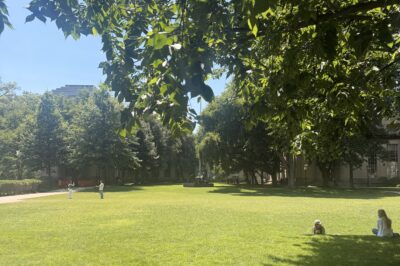
Sitting on Killian Court, in the summer, I get this feeling that I am both within and just outside of a painting.
Staring ahead, a low-hanging branch frames my vision in a gentle arc of bright green. The Dome, the entirety of main campus, provides a stately, serene backdrop. Just ahead, graduate students pepper the lawn.
When the tour groups arrive, they bring with them the blur between subject and observer. Cross-legged on a statue, typing away, I wonder if I’m a part of the exhibition: real-life MIT student works on real-life MIT research. Does this make me more official, an earned member of this institution, or more of a poser, performing my productivity?
A month ago, I was on Harvard’s campus, sharing the sidewalk with a visiting family. A little girl, I’d guess about five years old, zig-zagged across the pavement in an inspiring series of leaps and twirls. Eventually, her mom grabbed her hand.
“Do you like this place?”
“Yeah!”
“You know, if you want to go here, you’re going to have to work very, very hard.”
I could picture the memory settling in the girl’s brain. The sun hitting the Ivy League campus with vision-board worthy light, her mother’s conditional echoing firmly, motivationally.
Did I do that? Did I work very, very, hard?
At one point, this has to have been true. I trust the admissions process, so surely I had to have been diligent enough, overcome enough adversity, and demonstrated enough promise to land my role here, in the periphery of all these Great Dome photos.
But rather than reassure me, this thought distresses me. I get the sense that I lost something I once had. I must’ve known how to work hard, but I’ve forgotten now.
This feels illogical. Aren’t MIT classes a lot of work? Yes. Isn’t that work difficult? Absolutely! Yet, I complete each semester not with a sense of pride, but more with the sense that I just barely scraped through. Any achievement is processed as a tradeoff: I am better at one thing, but only because I accepted being worse at something else. I aced that 2.005 midterm, but only because my 2.007 robot couldn’t even flip a lever. I kept a good GPA, but only because I never took the time to apply to any internships.
And even if I’m forced to work hard during my semesters, any pretense that I’m actually a hard worker crumbles away during the summer. I snooze at least 3 alarms every day, despite getting more than 8 hours of rest. My 9-5 research schedule begins loosely whenever I wake up but ends strictly at 5. I convince myself that I’ve earned buying a coffee nearly every day of the week. I go on long walks and try new restaurants and buy more vintage clothes. In my ample free time, I think not about what I could be getting done but with whom I could be hanging out. I lament being “too easy on myself’ just about every 5 pages in my journal. Any todo lists related to post-grad preparation drift, unchecked, from one week to the next.
Yet, as long as I’m a student here, it feels as though everyone in my life is convinced that I’m just being too harsh on myself. How could anyone be lazy, at a place like this? Don’t you see the Great Dome? Doesn’t this institute promise greatness?
And when I think about it, I realize that this is why I dread post-grad. I’m convinced that there, wherever I end up post-MIT, is when my lost potential will finally be obvious to everyone, not just myself. Once I’ve graduated, it’ll be clear that the single greatest thing I am capable of has already passed. I spent my undergrad working, but not hard enough.
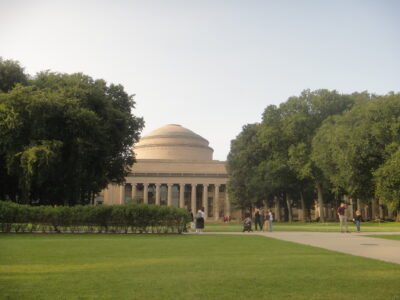
But for now, I’m still here, on Killian Court, grateful to have exciting UROP work just in front of me and a view of the Charles to my left. Another little girl, in a bright matching teal set, has started climbing on the same statue as me. We meet eyes and I smile. She compliments my shoes before asking, gesturing at the raised platforms:
“Do you think I can jump from here to there?”
“Of course you can. Do you think so, too?”