
Something to believe in by Janet G. '27
and say goodbye to
MIT is not known for its polish or ease. We are a cramped-up campus of noisy, scrappy, endless construction; we are college students who are too busy to look happy or well-groomed; we only really have two types of weather, too-hot-and-humid and too-dark-and-cold.
But we work with what we have: we make affectionate nicknames out of our buildings and all their odd shapes and histories; we embrace the camaraderie that comes from drinking the firehose; we hold onto the brief weeks when the sun peeks through the clouds, with bright blue skies and golden foliage and the shimmering Charles, and remember the other meanings of IHTFP.
We work with what we have, and we make something out of it.
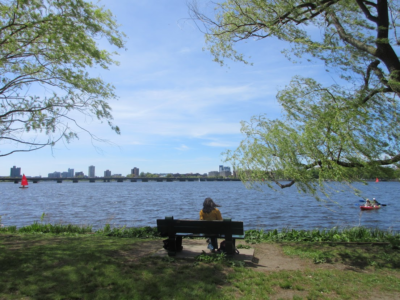
the shimmering charles
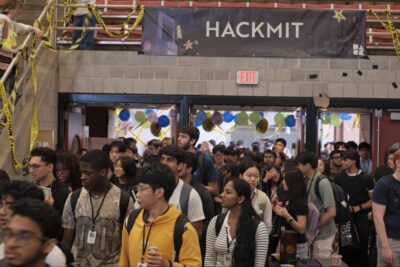
Let me show you something from September 19th. Come with me as I jump out of bed at 10am on a Saturday morning when I would otherwise be asleep; follow me through the dewy grass and under the big white tent that seems to have sprouted up on Kresge lawn overnight, and collect an engraved navy badge and an illustrated tote bag from some beaming sleep-deprived organisers in bright yellow hoodies; talk to the students lugging suitcases and neck pillows next to you and learn that they flew over from Berkeley or Illinois or Switzerland to attend this hackathon; join a thousand people in Kresge Auditorium to listen to 3Blue1Brown give his first in-person talk at MIT since COVID; follow the crowd outside past the laser-cut and heat-pressed wonderland-themed flags adorning the lightpoles; walk down the brick path and into the Z Center, 01 what we call our main athletics complex and look at how the grey and silver walls are now plastered with pastel streamers, shiny balloons, and jumbo-sized handmade playing cards; pick up a macaron from the snack stand and then put it down upon realising it’s just really well-made clay; go into the Johnson Ice Rink, the thing you might know as a grey, cold, concrete, hollow beast, and realise that it’s suddenly been taken over by rows and rows of pastel tables and pink lights and balloon arches and great big projector screens, and you could call it beautiful.


September 19th was the first day of my last HackMIT, the first one that I’ve attended and not organised. This blog is about HackMIT, the club I spent three years organising and directing. It is also about my life, the institutions I’ve been involved in, and how we’ve shaped each other.
I’ve been working on this blog for a year now. There’s always more I could improve on, more days I could spend writing, rewriting, revising it. But I’ve sunk enough time into it, and I need to move on. So even when there’s more to do, even when something is precious to you, we work with what we have, and sometimes we have to let things go.
To understand how HackMIT mattered to me, you first need to understand who I am.
I spent the first 18 years of my life living in Hamilton, New Zealand. Hamilton is the fourth-largest city in New Zealand, but most people stop caring after the top three.02 Auckland is the largest city and is what most people usually know; Christchurch is the largest city in the South Island and you might also know it from the shooting a few years ago; Wellington is our capital All the schools I went to were decile 5, certified average by the New Zealand education system. I never did out-of-school extracurriculars and spent most of my childhood rolling around in dirt, surfing youtube, and reading webnovels. I was the only second grader at my school asked to take a talent aptitude test, but they never followed up; I was nominated for Sports Girl of the Year at school because I won cross country, but only because the fastest girl fell over in the middle of the race; I lucked my way into the top three of my regional spelling bee, but proceeded to be the first person to get eliminated at the national bee. 03 it was a five-letter word from a list of words i was supposed to have memorised… latke… you never forget the word that gets you your fated ding
A stereotype is that MIT students are all labelled as exceptional from a young age: gifted, talented, prodigy. I was none of these things; I was an average kid who was smart enough, but only in my decile 5 school in the fourth-largest city in a small island country people don’t even remember to include on maps.
The only label I could describe myself with was hungry.
I was hungry to prove myself, and I jumped at every chance I had for a competition, which was not often when you’re from Hamilton. I never seemed to be the best, but I was relentless: I got a 0 on the maths olympiad entrance exam and came back for three more years; I spilled half the sample over my biology exam paper and finished my writeup on the soggy pages anyway; I was told by my junior debate teacher that I needed to “accept that [I] won’t always get a chance to speak when [better debater] needs the training opportunity more,” so I watched practice speeches on my own every day. I never won anything—always honourable mention, top 40, second place—but I never stopped trying. Honourable mentions can make it into the maths olympiad national camp, top 40s can win IBO04 the international biology olympiad silver medals, second places can captain the national debate team.
Maybe I’m just a
typical05
#forgotten #feelingoverlooked
middle child. My parents were always comfortable with my mediocre successes, since it allowed them to squabble and fuss over other things—my siblings, their jobs, each other. They reacted to all the achievements I brought home in the same way: a pleasantly surprised acknowledgement that lasted between ten and fifteen seconds. They had a stronger reaction when I told them that I wanted to apply to American colleges:
“Why would you want to do that? America is far. Also, you’re probably not going to get in anyway.”
They weren’t wrong. I was an aid-needing international student applying to top schools. So I leaned into the labels that would make me admissible: biology olympian, debater, theatre nerd, quirky kiwi. Fitting your life into a thousand words of application materials can feel like training to be a contortionist, but it was necessary to stand out as an applicant in a sea of thirty thousand.
When I got into MIT, I called my parents about it. The first thing my mum said was,
“How much does it cost? Why can’t you just do medicine at the
University of Auckland?06
Since the New Zealand school year ends in December, I was already enrolled at an NZ university while I was waiting for my college results. This is common practice for southern hemisphere universities, and also meant that I needed to persuade my parents to let me leave my NZ university.
You’d be a pretty decent doctor.”
But I saw a new identity tied to an institution that I’d barely dared to dream about. It would open doors, give me the resources and community to accomplish feats I couldn’t even imagine, and free me from needing to settle for the option my parents thought safest. I was going to prove my parents wrong: I wasn’t going to be a decent doctor comfortable with mediocre successes. After heated arguments, angry tears, and a generous financial aid offer, I was ready to call myself an MIT student.
My initial vision of an MIT student may have been overambitious: they were geniuses but also studious; they were firehose drinkers but also effortlessly organised; they were party animals but also led five clubs at once.
I thought it was doable; after all, I got into MIT. It couldn’t be that hard, right?
But MIT humbles everyone, whether you like it or not. I failed a 6.100A07 our intro to CS course quiz in my first semester and pulled a bunch of all-nighters over 8.0108 our intro physics course, mechanics. i HATED that class psets. I tried out 6-7 clubs and still dropped basically all of them. I hated debating in the APDA format,09 american parliamentary debate format; i debated in the world schools format in high school I got too afraid of the Shakespeare memorisation commitment, I wasn’t inspired to write poetry anymore, and I couldn’t afford to budget the number of hours required to enjoy Acapella and Mock Trial.
HackMIT was going to be just another club on the list. I forgot to apply to participate during the summer. I went to the organiser application info session only because friends said there was free boba. I also forgot about the organiser deadline, and only remembered when I saw a friend applying in the flounge at 10pm. I debated whether the long application was worth my effort, then wrote the app in 30 minutes and submitted at 11:50pm. I almost missed my interview the next day, and while I was excited in my response to the acceptance email, I was still thinking about the other applications I needed to fill out while I waited with the other new members to enter the welcome meeting.
Everything changed the moment I walked into the room. We were surrounded by cheering from Lili, Albert, 10 the co-directors of HackMIT 2023 and the rest of the team, and they kept the energy throughout the entire evening: we went through a million introductions with everyone’s names and class titles, a huge spreadsheet with comic sans and fluorescent colours and signup slots going from 6am to 9pm, an endless list of tasks, a countdown of five days until my first HackMIT, a vision of the chaos to come, and somehow all of it was getting transcribed by Albert at 200 wpm. It was then that I decided this community was for me, and I would do everything I could to become embedded in it.
But wait—what does HackMIT even do?
HackMIT is a student club at MIT which runs two hackathons a year.11 Hackathons are focused events in which people get a constrained window of time to prototype and demo a project in its entirety. HackMIT is also the name of our flagship collegiate hackathon hosted in the fall, while Blueprint is a hackathon for 300 high schoolers hosted in the spring. To disambiguate between the club and the hackathon, we will from now on call the club Hack. To run the events, we have a very structured form of leadership: team members are led by committee heads, who are led by one director during the Blueprint-planning cycle, and two directors during the HackMIT-planning cycle.
We start the school year with HackMIT, which is led by two co-directors. After HackMIT, the senior co-director retires, and the new solo director runs Blueprint, our high school hackathon. The team plans through fall and winter to run Blueprint in the spring, and director elections happen after Blueprint to elect a new junior co-director. The two co-directors then lead the team through spring and summer to plan out HackMIT in the fall, the now-senior co-director retires, and the cycle repeats.


Blueprint 2024: learning the ropes
Onboarding at my first welcome meeting was chaotic, but that’s just how Hack is: it skews younger as a club,12 in any given year, Hack is around 40-50% freshmen, 30-40% sophomores, and 10-20% upperclassmen so it trusts and expects new recruits to pick things up and run with them, whether you’ve had the relevant experience or not. This also informs the leadership structure: you can apply to be a committee head right after you join, and you can be trusted enough to be selected.
I was one such case: I ran for head of corporate relations right after HackMIT 2023, five weeks into freshman fall. I had to learn to scope out project timelines and coordinate with other committees, run weekly meetings and encourage team members when they were unmotivated, and balance our efforts between student outreach and corporate sponsorships. It was challenging. But in the end, I was proud of how Blueprint 2024 turned out.
It was now time for the next cycle of elections, and I had a lot of thinking to do.
Freshman year
I struggled a lot in freshman year. Some of the issues were about Hack, some of them were about moving ten thousand kilometres away from home and learning to live by myself, some of them were about being an MIT student. Everyone else seemed to be a great MIT student: taking more advanced classes while still doing well in them, landing internship offers at [Big Tech firms], doing meaningful research through UROPs.
So when I was thinking about running for director in the spring, I was also asking myself: What have I done with my life? I’d dropped all but two of my clubs. I could barely get through a pset without asking for help from friends. I hated the career fairs and had nothing to tell the companies. I found a research opportunity for the summer, but didn’t have much relevant experience and wondered if I would get anything out of it. It felt like all I was doing was struggling in my classes, feeling unhirable, and organising for Hack.
So in a way, Hack director was a label I felt that I needed: it was compensation for everything else that I hadn’t done. I wasn’t being a studious researcher, a technical intern, or an academic weapon. I was just a jobless quirky kiwi who did stuff with Hack.
I told my parents that I would show them just how much more I could do as an MIT student. What was I going to tell them now?
Director elections
I really wanted to become a director. I loved the club, and I had Opinions that I wanted to enact, but a big motivator was the insecurities I built up in freshman year, and I’m not going to deny that I felt competitive about it. After all, I spent years grinding for all-or-nothing competitions. But as I talked to the older directors and thought about why I wanted to run, I learned to embrace a different perspective: being a director is not just a title for your resume and ego, but a serious commitment that you will have to make sacrifices for. It is a role that you will grow a lot in, and you will be contributing to a community that you love, but the directorship isn’t the only role in Hack which provides that kind of fulfilment: committee heads also get a lot of leadership experience, and committed team members can also heavily shape the direction of Hack and get credit and growth for important projects. There are trade-offs to everything.
Two of my closest friends from Hack, Maggie and Alison, also ran for director. We doodled on the chalkboard, jumped up and down together to shake off our nerves, and coordinated “theme songs” that we would play when we entered to speak with the team. I was still nervous, but I knew that I could contribute to Hack as either a committee head or director, and I would get to work with Maggie and Alison, so these elections were going to turn out great regardless of the results. The point of director elections is to show the team a vision of what Hack will look like under your leadership, and to trust in their decision for the future they’re most excited about.
When I was announced as the newest director, Maggie and Alison swarmed me in a group hug, and we were once again jumping up and down together. They became some of the best committee heads who I’ve worked with, and are still some of my closest friends to this day.


After elections, I wrote in my notes app:
1. i am now director and that means that i have the weight of a team on my back. i have to be stronger with more personal resolve so that i can actually survive under all my responsibilities.
2. the people who run for hack director are also super passionate and i’m so excited for hack cycle heads and yayyyy
Becoming director was the biggest responsibility of my life; there was no turning back now. I couldn’t wait for the next 1.5 years. I told myself I’d do everything: I was going to lead the community, scale up the hackathon, and do whatever it would take to be the best Hack director possible.
HackMIT 2024: how to be a director
An institution is a relatively stable collection of rules and practices, embedded in structures of resources that make action possible – organisational, financial and staff capabilities, and structures of meaning that explain and justify behaviour – roles, identities and belongings, common purposes, and causal and normative beliefs. (March and Olsen, 1989, original emphasis)
— Why Institutions Matter, Vivian Lowndes and Mark Roberts
I joined as the 13th director to lead Hack. There had been over a decade of knowledge, mistakes, and adaptations built up before I arrived, and I spent the first few weeks as director absorbing as much knowledge as I could. At the time, this all felt like a slog through long conversations and notes app logs and Google Docs dating back years, but now I can formalise it: there were rules, practices, and narratives I had to learn, because these were the ways in which institutions (Hack) do their work (run a hackathon).
As the co-directors of Hack, Albert and I jumped into 6+ hours of meetings each week, for the committees, the team-wide generals, and syncs between us and committee heads. We started negotiating with MIT admin for various different things that we needed from them: overnight venue access, sponsorship packet approvals, so on and so forth. We pored over previous iterations of meeting notes to determine how we wanted to structure our general meetings, figuring out the messaging that we wanted the entire team to buy into: why do we spend so much time working on a hackathon? What does it mean for a hackathon to be good for the hackers? How do we want people to remember this hackathon?
Aside from all the director-specific problems, I learned much more about all the different committees in Hack. Every committee had distinct problems at scales that I’d never quite encountered before. We designed a new architecture to merge our major devops platforms, we experimented with new ways to make the theme more design-focused rather than illustration-focused, we negotiated with startups and tech firms to acquire hundreds of thousands of dollars, and we negotiated with MIT admin and restaurants and merch vendors to spend it. I had the resources to solve these problems, and I understood why people found power to be addicting. I could make things happen and it was awesome.
I leaned in, and let the title of Hack director consume my life. I quit ESP,13 Education Studies Program, a really lovely club that runs education events for mostly middle and high schoolers! the only other club I was in, stopped applying to jobs since I’d found my summer UROP, and spent all day outside of classes thinking about how to do more with Hack. Every bit of work I put in was reflected in our progress towards HackMIT 2024.
It wasn’t all sunshine and rainbows. I felt guilty about dropping the ball for ESP multiple times. There were days when I got back home after a day of class or a day in the lab, and had to resist the urge to rot in bed in order to sit through 3+ hours of meetings or battle a spreadsheet. I learned to manage my own emotions, to organise my time, and to communicate firmly but kindly to people when they slacked off. Hack was the reason I got out of bed, my doomscrolling mechanism, and the catalyst behind most of the ways in which I grew.
how to say goodbye, part one
HackMIT 2024 came and went. The play-by-play is in the old blog that I wrote. What I remember from it now is the pride that swelled in me as I stepped onto the Kresge stage; the chaos of running around during judging; rolling around in the moving carts as we wound down after a long day. I remember sitting with Albert and Emily 14 the Blueprint 2023 and HackMIT 2023 logistics head, and one of my favourite people ever <3 she made me feel super welcome in hack and was one of the big reasons why I loved hack so much in MacGregor after the hackathon ended, ordering burgers and fries from Tasty Burger and eating them with dining hall ketchup packets we saved, laughing about not being on the same wavelengths, thinking about how this was now the end of an era.
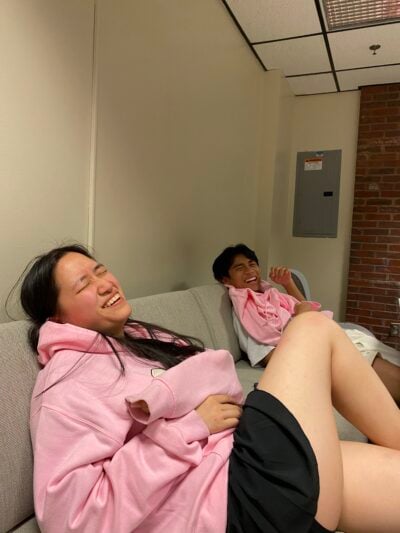
It might be an understatement to say that I was devastated when Albert left. He defined Hack as I had known it. I relied on him for advice both inside and outside of Hack, and we were two peas in a pod: sitting together in every meeting, always a topic to discuss, always a new joke to tell. Being a director was hard, but I knew that I could always rely on him when I didn’t want to run a meeting, or when I didn’t know how to have a difficult conversation, or when I just didn’t know how to do a certain task. Now that HackMIT was over, I had to run Blueprint by myself, and I had big shoes to fill.
Blueprint 2025: how to take on independence
Most major hackathon organisers only organise one hackathon a year: the amount of time required to invest in a thousand-person hackathon on top of school, work, and life is already a huge commitment. Still, we organise two hackathons and constrain ourselves to ~7 months for HackMIT. How does this high school hackathon justify the cost of needing to work all year round while compressing organising timelines for our flagship hackathon?
It’s because Blueprint is awesome. We teach high school students CS and hardware and make things for the sake of it, and we get to support educational access and give back to the local community. Having an extra cycle in the year also gives the organising team more opportunities to lead (e.g. allowing me to be a committee head before becoming director), grow (e.g. going through more iterations of the design / logistical / manufacturing processes), and experiment (e.g. testing out new initiatives at a smaller scale with lower stakes).


Where I learned a lot through co-directing my first HackMIT, I grew a lot through directing my Blueprint: I didn’t have a senior co-director to defer to when I wasn’t sure what to do, and had to take full responsibility for all my decisions and mistakes. I established new onboarding systems, tried out different team management methods, and ran meetings with my humble 120 wpm15 humble mostly because albert typed at like 200 wpm and transcribed for all the meetings and not-so-humble voice.
I initially imposed a lot of leadership baggage on myself. The team could lean on their committee heads when they struggled with work, the heads could lean on me, but I needed to be strong for everyone, so I couldn’t rely on anyone else, right? After my first Blueprint meeting as director, I packed up my laptop and felt a little hollow: it was just like my first meeting for HackMIT 2024, except now Albert was never going to walk back to BC16 burton-conner, the dorm that i live in. it also has a really nice main meeting room called the porter room, which albert and I worked a lot in with me to plot together. I guess this is the life of a solo director. But after everyone else had left, I saw that Claire17 the corporate relations head for hackmit 2024 and one of my closest friends <3 had stayed behind for me. We walked, arm in arm, back to BC, and we yapped about Hack and life and everything else, and the hole in my heart was filled.
I soon learned that I was wrong about being alone. My committee heads came to me for advice and final decisions, but I also learned to be vulnerable and rely on them when I needed help. The team also supported (and challenged!) me: Eddie and Nicholas stepped in from a different committee to manage a logistics task when we didn’t have enough people; Adam and Maggie pushed back on my harsh messaging around tardiness when I should have been more considerate of people’s lives outside of Hack; Teresa helped moderate an argument I had with our umbrella club when things got too heated. I was often overzealous about the things I could do and got stuck in my own head, and I learned to be more humble, understanding, and stable as we went through Blueprint 2025.


Sophomore fall
Sophomore fall was overwhelming in more ways than just solo-running a hackathon. I was taking some classes that I was struggling in, I joined the Admissions blogger team and started writing high-effort blogs, and I broke up with someone who started talking to another girl five days after the breakup. Moreover, the looming shadow of joblessness began hanging over my head once again.
It is a truth universally acknowledged, that an MIT student in possession of a CS education, must be in want of a technical job. Unfortunately, my freshman summer UROP mentor18 undergrad research opportunities, the MIT structure that supported us to do research with labs had ghosted me. I also just found wet lab to be too slow-moving and unpredictable, so I decided to try new projects. The only alternative to wet lab research was obviously computational work, so I attempted to force myself to apply as a software engineer/researcher like everyone else.
None of my applications were successful.
I coped with this by telling myself that Hack was also a resume-line item, and an important one at that; what other opportunity would let you say that you led a 40-person team with a $400k budget while you were still a freshman? But that didn’t erase the awkwardness I’d feel when I wandered through the career fair booths and struggled to name technical classes that I enjoyed, or make me feel proud to hand my sparse resume over to recruiters. I barely understood Python, I didn’t know anything about this AI wave taking the world by storm, and the biopharma companies didn’t take puny little sophomores.
But no matter; I was still a fall semester sophomore. I told myself that I didn’t need to worry about this job stuff right now, and I was just going down a path that wasn’t the conventional path career fair companies wanted. I might not have been the perfect MIT student they wanted, but I’d have time to figure it out… right?
how to say goodbye, part two
After Blueprint, I wrote in an update that I sent to some friends:
blueprint finished 💙 my heart is so, so full. there is a moment where i collapsed onto the chair and looked up at the lights and felt it all come crashing down, but after all of the emotions have left i just feel awash with joy.
when else am i going to call a hackathon so fully mine? so fully ours? the projects were amazing and i feel so impressed and inspired. it all paid off and it was worth it. i think, after all, this event will live in my memory as one of the best things i ever spent six months of my life doing
And with every change of cycle, I said another round of goodbyes. I cried when Maggie and Alison told me that it was time for them to go: I understood that they wanted to spend time on other things, but they had been there from the start, and suddenly I realised that Kimberly19 hack 2024 marketing head <3 i respect kimberly a lot and we learned from each other a lot and I were the only two from our Hack class20 people who joined Hack at the same time still on the team. I felt the same sorrow with Annie,21 blueprint 2025 devops head!! my goat with Claire, with Selena,22 blueprint 2024 marketing head! we were heads together and i love selena so much with everyone else who I’d been through thick and thin with over the past year and a half.


With Blueprint wrapped up, I had to think about the big questions left:
How was I going to say goodbye?
how to say goodbye: the beginning of the end
To say goodbye to an institution and help it move on without you, you must set up a legacy. I started looking for a new co-director, and I was left in a conundrum. Somehow, nobody seemed like they really wanted to run for director.
I had conversations with all the eligible fall recruits, and it always felt like there was a missing piece, but I couldn’t quite put a finger on what it was. I started getting really insecure about the way that I had run my Blueprint, because maybe there was an issue with how I had mentored them. I wondered whether the fall kids didn’t want to work with me, whether they thought I complained about the work a little too much, whether they just didn’t believe in the Hack community I’d built. I started spiralling about my leadership abilities and feeling more self-conscious than ever, and I would sit around and complain to my heads and doom about the future of Hack.
As it turned out, my worries were unfounded. When elections came around, two wonderful candidates ran for director. I stressed myself out because I hadn’t seen myself in the fall kids—I hadn’t seen the same desire, the same skillset, the same personality; but you didn’t need to be like me to be a good director. It was too presumptive for me to project my own motivations onto the next generation, and after elections, I was really excited to work with Sanjith for my last HackMIT.
HackMIT 2025: how to get through the last mile
I went into my last HackMIT with a series of expectations based on HackMIT 2024, but I was with a new crowd: a new team, a new set of heads, a new co-director.
Maybe it was because I’d been off Instagram for half a year by then, but I was deeply confused by every online reference that Sanjith pulled out at meetings, while he would roast me for being an unc who sent him facebook reels over Slack. We bantered our way through the onboarding and heads selections, and despite being initially unsettled by his type B approach and brainrot cultural differences, I was soon able to trust and rely on him for when I was spread too thin or when we needed to solve a random issue that popped up. I learned to appreciate his laidback leadership style, which once again reminded me that you didn’t need to be like me to be a good leader. Our committee heads and wider team were also energetic and creative in ways different from HackMIT 2024 that I came to embrace.


We also faced a new set of problems. I was really excited about the energy of our team, and fundraising had gone extremely well due to a combination of the funding landscape and changes in our sponsorship style, so we pushed to scale everything up much more ambitiously. We admitted more people, spent way more money, and set up many more fun perks for the hackers. However, our systems couldn’t adjust to it. We spent days dealing with the fallout from disastrous bugs on our app-reading systems, called up a bunch of last minute merch vendors because of new branding policies, and had to make a last-minute change in judging when our scheduling system broke on the day of HackMIT.
In retrospect, I wish that I’d taken more time to really think about how the systems interacted with each other and designed better contingency plans, but the true lesson here is that organising an event is like playing whack-a-mole: prepare all you want, but new problems will pop up when you least expect it. That’s the fun of it, after all.
Sophomore spring
I loved Hack and its people. Still, after repeating the same playbook for 1.5 years, I started getting tired. I was running the same meetings for the third and even fourth time, saying the same things for the sake of knowledge transfer.
Alright, so for those of you who have done hackathons before, can we popcorn around and talk about what really gives a hackathon their spark? What were the most fun core memories?
No, we can’t try to advertise on this bulletin board, because two years ago we tried this and it
got taken down and we got a talking to…
Let’s talk about how we can improve the sign-in logistical experience! Imagine that you’re a hacker, what would be the easiest sign in workflow…
Now that the novelty of Hack had worn off, I started really feeling the opportunity cost of choosing to spend time on Hack rather than my career. I was committing to research again for the summer, on a more computational bent: I was reasonably excited about what I’d get to learn, but I was also a little disappointed by the fact that none of my internship applications had gone well. Sometimes I felt irritated that I had to work on meeting notes and random logistics while my friends were talking about all of their interviewing and leetcoding and whatever else.
School wasn’t going great either. I got my first B in a class, and then I got another B, and I knew that if I had submitted some more psets on time and studied more, I would have avoided this fate. But there were meetings to attend and tasks to do, and I continued submitting psets in the middle of a meeting and cramming for exams at the very last minute because it was a crunch week for Hack. At this point in college, I’d developed a more calibrated view of what it means to be an MIT student. It’s fine to struggle in your classes, and it’s fine to need a lot of help. But sometimes it felt preventable, and Hack was the reason why I couldn’t do better.
What the older directors had told me about didn’t sink in until now: the last-cycle slog, the accumulation of sacrifices that you make, the moments when you doubt whether this was all worth it. I just had to remind myself: I committed to this not because it was easy, but because I would grow from all the challenges, and I was still learning to prioritise and grow and mature as a leader. We were so close to the finish line, and I was going to see it all through. I represented Hack to so many people—my friends, my team, myself—and Hack was the one thing I really believed in, so if I didn’t organise it the best I could, I wouldn’t be myself anymore.
In the month leading up to HackMIT 2025, most of my frustrations and struggles eventually got resolved. I always found the worst part of planning to be the uncertainty, because it enables the nagging at the back of my mind that I should push harder to find a better option, and overwhelms me with the prospect of an endless option space. But once I make a commitment, I can free myself from my anxieties, and let myself enjoy the ride. I was able to let go of a lot of the leadership baggage and dissatisfaction that I’d collected over my time directing Hack, and it felt like HackMIT 2023 again: the flurry of activity, the excitement that new Hack babies brought, the anticipation of the Event of the Year.
interview today:
kid: have you felt like hackmit has helped you grow in life outside of hack? how have you grown with the committee?
me: what life outside of hack…
had a meeting w marketing ppl. big gsd,23 get stuff done session, i.e. a worksession culminated in dinner after rainy day. really moving for some reason. i made all the letters w ivy and as we made them i was struck by how fun and beautiful it all was and how this was going to be my last hack. we ran through the rain to 5 spice24 classic restaurant in central square and ordered a big table of food and i was so proud about guessing the price. the rain settled on the way back and i jumped in the puddles to terrorise kimberly with her umbrella, and we took our sweet time to clean up all the cellophane and put hot glue guns up and carefully moved all the big foam cutouts into the corner and made a little enclosure for them like they were our children. i just want to spend a little more time with hack, just a little longer


the things you leave behind
Time doesn’t stop for anyone. So, despite all my attempts to savour every moment and hold onto the time I had left as director of Hack, as difficult, fun, painful, fulfilling as it had been, the clock struck midnight and my time came to a close.
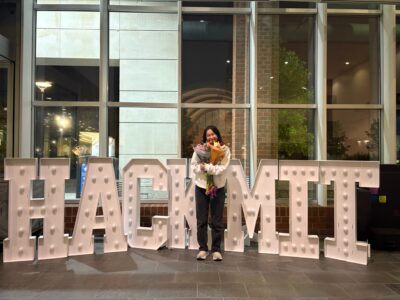
the end
A part of me was struck by how different my initial campaign promises were from the hackathons I actually ran. I came into Hack with a lot of drive: I was going to learn all about hackathons, I was going to grow as a leader, and in particular, I was going to lead the club to finish the biggest projects that my predecessors weren’t able to complete.
I wanted to define my time as Hack director through completing two projects: getting overnight venue access for HackMIT again, and seceding from our umbrella organisation to become our own student group. I did everything I could—reaching out to famous alumni and rallying for support, calling emergency meetings and writing up twenty-page pitch documents, burning bridges with leadership—in passionate and sometimes irresponsible ways. At the end of my directorship, neither of the projects came to fruition.
To cope, I had to remind myself that the most important part of the directorship is the hackathon itself, and in that sense, I was happy with what I’d done. I saw first-time teams celebrate their first energy drink (or ten); I saw people tinkering away with hardware they’d never used before because we opened up the makerspaces; I saw bird call classifiers and soil batteries and coordinated cow onesies. I announced that there was a matcha bar and saw the ice rink erupt in joy. I saw old friends and met new faces, and they all hacked and built for the love of the game.
And at the end of my time in Hack, I really did feel like I learned the essence of the hackathon. In my initial post-Hack reflection, I wrote about the part of Hack that I was proudest of:
To be completely honest, by the time the hackathon swung around fully I felt very torn. On the one hand, I was so proud of the work we had done as a team—raising money, coordinating logistics, building platforms, and most visually all the BEAUTIFUL merch and deco that we had done; on the other hand, I felt very disillusioned about the state of the hackathon.
Believe all you want about the idealism of a hackathon—a crazy fun sprint of experimenting and building, hanging out with friends and hacking at a project together, learning to prototype and build—but as an organiser, if you want to understand how people will react to and interact with your hackathon, the clearest way is to distill a hackathon to its functional purpose. Hackathons are often seen by sponsors and hackers as a quirkified career fair. You spend two days to build a demo using [insert LLM coding assistant of choice], and it doesn’t really matter how functional it is, as long as the UI looks good and you can sell the grand potential of the demo. Importantly, this is not a fault of the hackers. If you win the hackathon with that skillset, good for you. We just ran judging in a way that wasn’t aligned to what we value in hackathons.
We tried out a new judging scheme this year, and I’m proud of how it went. The top project was the kind of dream that I think an MIT hackathon deserves: an honest-to-god trashy pitch, but a fully functional product and backend that was hand-written in haskell which rederived gradient descent for non-euclidean distances. Yes, scrappy, nerdy, insane. But that’s the point.
We’re at MIT, after all. I’m at MIT, I ran HackMIT, and I’m so proud of it.


There’s a Chinese saying which has stuck with me: 成长是让人生磨平你的棱角 // growth is accepting that life will smooth out your rough edges. I had plenty of rough edges and ambition when I came into Hack; I wanted to do big projects and revamp everything and work through the last mile because I thought I had the agency and dedication to do so. But life humbles you: I ran into endless obstacles from factors outside of my control, and eventually I had to learn to accept and move on.
With humility comes gratitude, and I have so, so much to be grateful for. For HackMIT 2025, a lot of friends from my prefrosh days came to support—as judges, sponsors, and hackers alike—and they brought flowers, chaos, and memories that imbued so much joy into my final HackMIT. I’ve met countless mentors who have shown me what good leadership looks like, and peers who challenge my decisions and support me when I can’t fix issues myself. I saw our team members grow from fresh-faced Hack babies into the backbones of the team.
With gratitude comes perspective. It was naive for me to promise that I’d deliver what others couldn’t, or act as if I ran MIT’s largest hackathon. It would never be just me who did these things. It was us: it was me and Sanjith, it was the heads, it was each and every single member of the Hack team. It was the predecessors who had set everything up before us. It will be Laura, and all the future co-directors and heads and team members, who will take up the torch. I would not be the one to finish the mission, but I passed my knowledge and ideas onto the next generation, and that will be enough. 前人栽树,后人乘凉 // the predecessor plants the tree, for the successor to take shade beneath.


how to say goodbye, part three
Now that I was leaving, I saw the emotions in others that I had felt, the sense that Hack as they knew it would never be the same. But that’s the beauty of an institution: it was here before you came, and will last long after you leave it.


I turned 21 at some point: the people who planned a birthday surprise for me at midnight were many of my closest friends, the vast majority of whom came from Hack. I joined Hack when I was 18, and left on the cusp of turning 21. I’d given it some of the best years of my adolescence, and now I’d crossed some invisible boundary into legal-american-drinking-and-other-adult-things land. It was time for a new life.


Junior fall
Many people asked me what it felt like to be done with Hack, what I was going to move onto, how it felt to be finally free.
At the time, I’d written:
I feel released and not free. The distinction here is that “free” to me implies “free to do [something]”, which isn’t how I feel? There’s not quite anything that feels HackMIT-like in the space of my life yet. I feel released from a burden (for what it’s worth, a loving one), but it’s unclear what I can put this new time into and still get similar amounts of fulfilment. Currently I’m using the free time to rot and recover from sickness, but honestly the rest is TBD
Retiring from Hack removed a big part of my life, and I gradually realised that the emptiness wasn’t in my schedule as much as in my mind. I deleted Slack off my phone to take a complete break for the first time in three years: now, when I was bored, my muscle memory yielded nothing on my phone and I remembered that I didn’t have to do anything for Hack anymore. I spent the first few weeks feeling anxious about needing to Do Things when 10pm25 when the general team meetings are typically held came around, until I realised I could just go hang out with my friends.
I didn’t pick up any clubs after Hack, because life just expanded to fill the space it was given. I could now procrastinate on problem sets until the last minute and do perfectly fine on them; I could spend weekends travelling around; I could go out to dinner with friends and forget about my phone until after. My life was smaller and more free-form, and everyone told me that I looked relaxed for the first time in my life.
Now that I had time, I also confronted the shadows that had loomed over me for the past two years: joblessness and academic mediocrity. I wasn’t afraid of not belonging as an MIT student anymore, but I wanted to prove to myself that I could do well in these areas if I’d put the time into it.
I got all A’s that semester: I still struggled with psets and exams, but I was proud of recovering from a disastrous midterm, and I enjoyed having the time to learn much more in-depth from my classes.
I tried to do research again, although that still didn’t work out as I’d hoped. I also went to recruiting dinners and career fairs and interviewed for a few places in an engineering capacity, but none worked out either. But now I had the time to reflect on it more: maybe engineering and research just weren’t the things I’m interested in. I found an opportunity to work at a company over IAP26 our january term, where we have a month to do whatever before the spring semester in a non-technical capacity. I admit I was planning on using it as a springboard to a more technical role, but I ended up finding the most value in the deeply human parts of my work. I loved the communication, the strategic prioritisation, the systematisation, the understanding-how-to-work-with-people parts of it.
It’s hard to describe the work I do these days: people are confused when I tell them I do ‘strategic operations’ and ‘special projects’. In some sense, the point is that these roles are hard to define, because they require generalist abilities and adaptability and systematisation. I review contracts and write briefs and do research and build systems which involve people and money and understanding really cool technology, and the best example I can give is honestly, really, just ‘Hack director’.
If I’d never been Hack director, I’m not sure if I would have realised how much I love doing similar work. A lot of my friends treat their work as a commitment to compartmentalise away from the rest of their life, which I understand, but it is just not how I operate. I like to get consumed by the work I do, to be dedicated to something I deeply believe in, and I’m grateful that Hack gave me an opportunity to seriously try it out. It’s not as well defined as being a SWE, or a quant, or a pre-med, or a scientist, but I now have the confidence to define a path for myself.
I was never good at work-life balance, and retiring from Hack was even more difficult. Hack had fundamentally shaped my professional, social, and personal life, but as a retired director, I had to make sure my presence was completely removed from Hack after I left.
There’s a reason why directors alum as soon as they retire from being director: not only are the marginal returns on learning greatly diminished after your second hackathon, but you also don’t want to overshadow the current director who is trying to run their own hackathon. It was tough running Blueprint as a solo director, but if I hadn’t done it independently, I would never have grown as much as I did.
So I would hear about all these happenings through the grapevine, and I would occasionally walk past Building 1 around 10pm, and I would see clusters of Hack kids meeting in Stud. It was so tempting to go in and pipe in with my opinions, my experiences, how I thought things should be run. But there was Sanjith, and then Laura joined, and then there will be the next co-director, so on and so forth. This was no longer my hackathon, it was theirs to frolic and suffer and grow through, and I needed to let that go.
something to worship
Because here’s something else that’s weird but true: in the day-to-day trenches of adult life, there is actually no such thing as atheism. There is no such thing as not worshipping. Everybody worships. The only choice we get is what to worship.
—This is Water, David Foster Wallace
Section TW: mental health, self harm
When I was younger, I was religious, awkward, and lonely. I grew up going to a local church as my only community outside of school hours, where the kids mocked me for my bad English pronunciation and ill-fitting clothes, and the adults told me that my dad was going to burn in eternal suffering if I didn’t persuade him to come to church. Every time there was a church meeting, I sat in the corner of the kids’ room and read Chinese webnovels while the other girls made loom band bracelets from their kits and bragged about the newest Rainbow Magic books their parents got for them. When I hung out with them, we did so with the understanding that I’d be the last one chosen, because I wasn’t really one of them: I didn’t go to their Chinese school or dance with them or read at the same progression as them. So I read my webnovels and dreamed about the day when I would find vindication like my heroines: once ostracised and mocked, eventually growing to self-assurance and power by the hand of fate, and in my case, God.
Maybe I was hungry out of spite. I don’t know for sure, but I do know that I was relentless and unstable. I prayed to God and thought that everything I had ever achieved was merely a blessing or a curse based on the quality of my prayer. I worked very hard, but I didn’t believe in my own ability to succeed, so I instead believed in God’s ability to help me. This worked well until I started failing constantly, I started thinking that maybe I just wasn’t supposed to succeed, because I wasn’t one of God’s chosen ones after all. I spent many nights crying on my bedroom carpet, questioning why I existed in the way I did, whether I was here to be redeemed or punished for being the sinner I was. I didn’t kill myself, because I was afraid of failing, but I had told friends that I didn’t feel tethered to this world and that I wouldn’t mind not having to exist anymore. Besides, when you’re young and depressed, there are plenty of other ways to punish yourself.
I left the church around the end of high school. It was a traumatic community that I didn’t want anything to do with, and I’d finally been honest with myself about how I felt about this community and the way they treated people like me. But when I left religion, I was drawn into another community that was cultish in their own ways: they handed me a $50k scholarship, a rational value system, and a new heroic drive to save the world from some new impending doom. I fell in love with the community, which definitely helped me leave the church, but fell out of love with it just as quickly, for reasons I won’t get into here. So when I’d started at MIT, it was the first time that I was truly free from an institution that pushed intense beliefs on me which I was deeply afraid of questioning. It was the first time that I could choose an institution for myself.
what will you worship?
As we live our lives, we play our part in both reinforcing and undermining the institutions around us. Institutions exist in every sphere of our lives, the social, economic and political. Marriage, markets, mosques, media… these can all be described as ‘institutions’. They all create ‘patterned interactions that are predictable’.
— Why Institutions Matter, Vivian Lowndes and Mark Roberts
I missed the Activities Midway27 a club fair: an event where basically all the registered clubs at MIT will gather in the johnson ice rink to set up a booth and talk about their club to students during REX28 residential exploration, where the dorm upperclassmen throw events to help the prefrosh experience dorm culture, which in my opinion mostly defines the week of orientation this year, but after six Midways myself, I don’t need to be there to know how it goes. Year after year, hundreds of student clubs pile into the Johnson Ice Rink to talk their heads off at wide-eyed freshmen / prefrosh to persuade them to join their club. We are tired, our throats are fried, we get bored of saying the same thing a thousand times for everyone that shows up at our table, but we do it anyway.
During Midway, every club is the same: they are proselytising the idea of their club, to find people who would like to join their community, but perhaps more so to find the successors who will repeat these same pitches to the generations down the line.
A religion is an institution, as is a workplace, as is a college, as is a club. Institutions are complex, beautiful, fragile, and resilient. Over the course of your life, you will join and contribute to institutions that were here before you came, and will stay long after you leave it. When you are young, you will be drawn to many institutions, and many institutions will be drawn to you. They want the promise of malleability, of potential, that you will be able to join them and contribute—to become a pious follower, a stellar engineer, a famous alumnus, a hardworking leader. You will have to choose some and support or challenge them—often both—and you will in turn be changed by them. This is inevitable, but beautiful, because it reminds us that we are not alone. We are together in this present moment, but we are also together across time—with those who preceded us and those who will follow—all bound together by our shared belief.
I am not telling you which institutions to choose, or how to feel about institutions in general. You can choose multiple, and engage with them on varying levels; Hack director was not the only label that captures who I am, but it was an example of what I actively chose and leaned into. This essay is a case study in commitment: how I chose something to believe in, how I’ve questioned it, how I’ve both changed and been changed by it. Perhaps there are things that have resonated with you, or things that are a completely new perspective. I just hope that you will find something to truly, deeply believe in, to have the privilege of loving something to the point of sacrifice.
something to believe in
Let me show you something from September 20th.
Come with me as I roll out of bed at 10am on a Sunday morning when I would otherwise be asleep; follow me through the hundreds of projects lined up in the ice rink, past the beaming sleep-deprived-red-bull-fuelled hackers gushing about the project they finally got to work, up the bleachers, and look at everything that is happening in front of you. Thousands of hours have been collectively put into this hackathon, hundreds of hours that I once put in myself. There will be prize-winners and space weather balloons and GPUs built from scratch, but we will not dwell here. We congratulate the even-more-sleep-deprived team on a magical hackathon—magical not least because we’re no longer distracted by the stressful logistics behind the scenes and the exploding pings on Slack—and then we will go grab dinner with friends.
At 7pm, when it’s dark out, walk with me by the Z Center29 in case you’ve forgotten, it’s the athletics center, and also where the johnson ice rink (hackmit’s main event venue) is located once again, and there we will pause. Look—from a distance, you can see the cheery yellow hoodies milling around inside. We wave to them, but they’re too busy to notice us. They’re taking the decorations down and distributing mementos for their dorm rooms, stacking the pizza boxes on the bins and marking out people’s heights next to them, leaning on each other as they sing karaoke on the big projector screens. They made something out of all the resources they collected and challenges that they ran into, something magical and beautiful, and they are holding onto these final moments for as long as possible. For some people, these will be the last moments of their final HackMIT; for some people, this is only the end of their first.
Next week, a new cycle will begin, and a new round of goodbyes will be said, and some people will leave. This hackathon-running institution will stay: it will roll on to the next cycle, and the next, and the next.
We turn away from the window, and go our separate ways.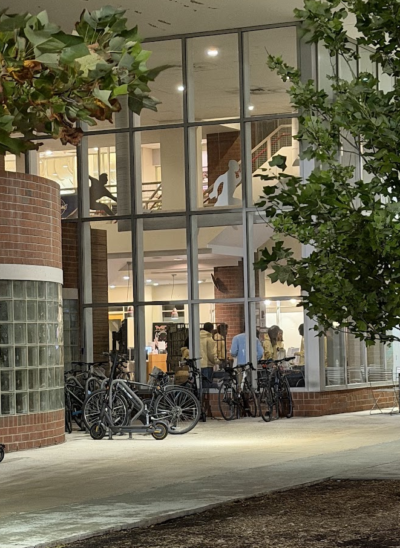
With thanks to Petey and CJ for comments and inspirational blogposts of their own. With special thanks and deep gratitude and everything else I can offer to my worst best friends and best editors: Espen “most github committed” Slettnes, Edward “mediocrely successful” Yu, and Elena “dewy grassy Tyson” Baskakova, for extensive
late-night30
and early morning... because if mcdonalds starts their breakfast menu then surely it's the morning
feedback, suggestion, support, and trolling as I battled this piece for hundreds of hours. I couldn’t have done it without y’all—thank you for being essential critics and editors for the most difficult piece of writing I have ever done, and helping me finally close this chapter.
- what we call our main athletics complex back to text ↑
- Auckland is the largest city and is what most people usually know; Christchurch is the largest city in the South Island and you might also know it from the shooting a few years ago; Wellington is our capital back to text ↑
- it was a five-letter word from a list of words i was supposed to have memorised… latke… you never forget the word that gets you your fated ding back to text ↑
- the international biology olympiad back to text ↑
- #forgotten #feelingoverlooked back to text ↑
- Since the New Zealand school year ends in December, I was already enrolled at an NZ university while I was waiting for my college results. This is common practice for southern hemisphere universities, and also meant that I needed to persuade my parents to let me leave my NZ university. back to text ↑
- our intro to CS course back to text ↑
- our intro physics course, mechanics. i HATED that class back to text ↑
- american parliamentary debate format; i debated in the world schools format in high school back to text ↑
- the co-directors of HackMIT 2023 back to text ↑
- Hackathons are focused events in which people get a constrained window of time to prototype and demo a project in its entirety. back to text ↑
- in any given year, Hack is around 40-50% freshmen, 30-40% sophomores, and 10-20% upperclassmen back to text ↑
- Education Studies Program, a really lovely club that runs education events for mostly middle and high schoolers! back to text ↑
- the Blueprint 2023 and HackMIT 2023 logistics head, and one of my favourite people ever <3 she made me feel super welcome in hack and was one of the big reasons why I loved hack so much back to text ↑
- humble mostly because albert typed at like 200 wpm and transcribed for all the meetings back to text ↑
- burton-conner, the dorm that i live in. it also has a really nice main meeting room called the porter room, which albert and I worked a lot in back to text ↑
- the corporate relations head for hackmit 2024 and one of my closest friends <3 back to text ↑
- undergrad research opportunities, the MIT structure that supported us to do research with labs back to text ↑
- hack 2024 marketing head <3 i respect kimberly a lot and we learned from each other a lot back to text ↑
- people who joined Hack at the same time back to text ↑
- blueprint 2025 devops head!! my goat back to text ↑
- blueprint 2024 marketing head! we were heads together and i love selena so much back to text ↑
- get stuff done session, i.e. a worksession back to text ↑
- classic restaurant in central square back to text ↑
- when the general team meetings are typically held back to text ↑
- our january term, where we have a month to do whatever before the spring semester back to text ↑
- a club fair: an event where basically all the registered clubs at MIT will gather in the johnson ice rink to set up a booth and talk about their club to students back to text ↑
- residential exploration, where the dorm upperclassmen throw events to help the prefrosh experience dorm culture, which in my opinion mostly defines the week of orientation back to text ↑
- in case you’ve forgotten, it’s the athletics center, and also where the johnson ice rink (hackmit’s main event venue) is located back to text ↑
- and early morning... because if mcdonalds starts their breakfast menu then surely it's the morning back to text ↑