
electric energy systems by Victor D. '27
my first EE class?!
I’ve been wanting to talk about my classes and post my notes!! But I have too much to say about one of these classes, so I’m giving it its own dedicated post.
I decided to take this class on a whim when I received the syllabus for 6.220 (Electric Energy Systems) in my inbox from DUSP Professor David Hsu, whom I took a class with last year (Infrastructure Systems in Theory and Practice). I’m so enamoured by this class: it makes me want to learn so much more about power engineering.
The class is about a lot of things, but it ties together by focusing on the electrical grid, the infrastructure system so foundational to all of modern society. Turning on a switch may as well be magic but behind the scenes are complex systems of generation, transmission, distribution, and markets that make it possible.
Last week, we took a bus to Schenectady, upstate New York, to visit the GE Vernova labs there. They showed lots of cool grid technologies they are working on, and gave us a talk on the history of the power engineering industry. I’ll touch on some of those stories and technologies of the power industry here.
Maybe you’re familiar with the so-called “War of the Currents”: the AC/DC (Alternating Current/Direct Current) debate of the late 19th and early 20th century. Proponents of DC such as Thomas Edison argued that DC should be chosen for the electrical grid, in part because he was already invested in the power generation industry, and a DC grid would require more power plants.
On the other side of the debate were figures like George Westinghouse who argued AC should be the grid standard, given the extreme limitations of DC: back then, many of the power electronics (electronics used in the conversion of electric power, such as stepping down a DC voltage via a DC-to-DC converter) we take for granted had not yet been invented, meaning that low-voltage DC power transmission required a relatively high current to deliver useful power.
From electricity and magnetism, we know that Ploss = I2R, where P is power in Watts, I is the current in Amps, and R is the resistance of the power line in Ohms. Thus, DC transmission as envisioned by Edison required power plants to be sited near where power would be consumed, since the voltage would have to be low with high current; high current would mean untenable losses if the power plant were too far from where the power would be used
Enter AC. Transformers, a commonplace technology used to step up (increase) and step down (decrease) the voltage of AC transmission, already existed during the late 19th century. Transformers consist of wires wrapped around a ferromagnetic core. The difference in the number of turns on each side allows the transformer to exchange voltage for current and vice versa.
a three-phase transformer :)
Let’s assume we have an ideal transformer such that Pout = Pin (i.e. power is conserved; there are no losses). Since P = VI, where V is the voltage in Volts, an increase in voltage must result in a proportional decrease in current. Thus, we are able to produce electricity at an AC power plant, step up the voltage using a transformer to extremely high voltage to send it along power lines well away from any person who might touch it, and then use another transformer near where the power is being supplied (such as a home or business) to step down the voltage to levels suitable for customer use.
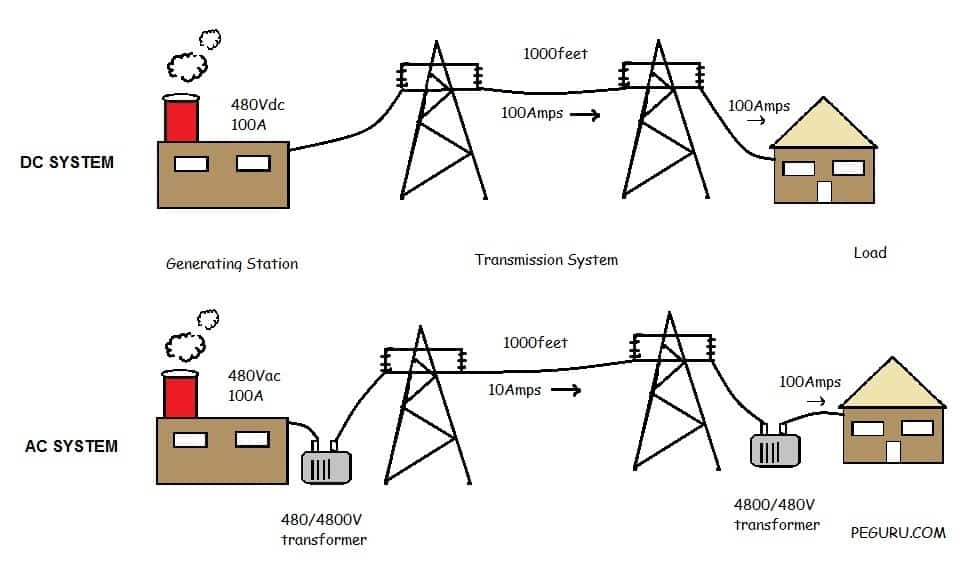
In the above example in the DC system, Ploss over the power line due to the resistance of the wire would equal P = 10,000 × R where I = 100 Amps, whereas in the AC system, it would be P = 100R where I = 10 Amps, 100 times less assuming the same R.
Although today we have some HVDC (high voltage direct current) lines for long-distance transmission since modern power electronics allow us to step up and down DC voltages, the grid itself is still three-phase AC at 60 hertz (at least, in the United States). In the end, Westinghouse and AC proponents won this tussle: a coal power plant could be located well away from the city, spewing noxious fumes and transmitting power to urban areas.
Transformers are a hot topic right now though, for 2 reasons: (1) the AI data center boom, which has resulted in a backlog of transformers (which are still largely manufactured by hand by specialized artisans) and (2) the electrification of the transportation industry, which is the least electrified major economic sector in the United States. Given how many electric vehicles are expected to be on the grid, the question becomes how we can support all these new loads, or alternatively, how we can utilize all these new batteries for grid-energy storage.
To bring this back to my urban planning interests, consider the electrification of school buses. Because school buses are only used at certain times of the day, their batteries can be used as grid-energy storage and discharged at peak periods (such as during the evening when people come home from work) while the buses are sitting unused in the bus barn. This technology is known as vehicle-to-grid, if you’re curious to read more. It’s exciting, actually important, cutting edge stuff, that unfortunately does not receive as much traction as agent swarms or space data centers.
Anyways that got too woke too fast… I like this class because of how it interfaces between the history of the grid, engineering principles, and the physics itself. It’s very grounded. Badum tsch.
There is much more to be said about the grid, and I have refrained from nerd-sniping too hard here. but like comment and subscribe for more!1! And finally, here’s the notes, as promised. I will soon also post my notes for my Course 11 classes :3.


