
[Joint Blog] What It’s Like Studying Design at MIT by Gloria Z. '26 MEng '27
Recounted by two seniors
[This is a joint blog with Teresa!]
Gloria:
Have you ever wondered what it’s like to study design at MIT? Did you know that there are only four design majors in the class of 2026 (and that Teresa and I are two of those four)? Now that we’re both entering our last semester at MIT, we want to record what our experience studying design here has been like. Because the program is so small, it can be hard to find information about design-related classes and opportunities both online and within the student body, so we hope that this blog can be a thorough resource for prospective design majors/minors or just anyone curious about what the design program within MIT is like. It’s pretty long, so buckle in!
Table of Contents:
- The design department at a glance
- What is design (at MIT)?
- Classes you would take as a design major
- The design department upon closer inspection
1 – The design department at a glance
Gloria:
So… there actually is no designated “design department,” at least not right now. The course number for design is 4-B, and it exists as more of a sibling of Course 4, or architecture. That means that all of our classes are prefixed with 4 (e.g. 4.021). It’s also technically a B.S. in Art and Design (BSAD for short), and students can certainly take it in more of a fine arts direction versus design direction, depending on what electives they choose. From here on, though, I’ll just refer to the major as design for brevity.
The major itself is quite young; up until recently, it was actually called “Architectural Studies” and functioned more as a flexible counterpart to the more rigid, studio-based Architecture major. In 2018, it was reworked into a dedicated design major, and since then, the program has been constantly evolving and changing as it establishes its identity. Just in the 3.5 years that we’ve been here, we’ve seen design classes, programs, and opportunities change, disappear, and sprout anew.
There’s also something called the Morningside Academy of Design (MAD), which was created in 2022 as an “interdisciplinary hub that celebrates the transformative power of design at the Massachusetts Institute of Technology and beyond.” MAD is a bit hard to pin down—essentially, it’s not a major or department in its own right; rather, it encompasses a bunch of programs meant to foster design thinking and interdisciplinary efforts across campus. For example, MAD oversees one of the first-year learning community options, DesignPlus, which Teresa and I were both a part of in 2022 (and fellow blogger Ellie in 2024)! We wrote a whole joint blog about DesignPlus that you can read here. The first iteration of DesignPlus actually took place in 2021, so you can see just how new these programs are.
A couple other projects that MAD oversees are the Design Fellowship, which financially supports graduate students in any MIT department “whose work engages design in research, practice, or both,” and DesignX, an incubator/mentorship program that supports the creation of design-oriented ventures and startups. MAD also runs workshops, programs, makerspaces, etc. Thus, although there isn’t much “official” overlap between MAD initiatives and the actual design major coursework, they are certainly interrelated in a lot of ways.
2 – What is design (at MIT)?
Gloria:
The architecture department’s website states:
[T]he Bachelor of Science in Art and Design provides a rigorous but flexible program of study in which students learn fundamental principles of art and design and pursue an area of concentration across a spectrum of possibilities… The objective of this program is to prepare students to pursue diverse career paths in multiple areas of art and design from product design to visual communication to information design to 2D and 3D art practices and more.
In my opinion, this description is appropriately vague. Design as a methodology and discipline is so broad and widely applicable that it can really be channeled in any direction. In my experience, every undergrad I’ve met in the design program has a different focus and different interests, and they’re almost always studying design in conjunction with something else, whether it’s computer science, business, mechanical engineering, materials science, etc.
For example, I’m studying design and computer science, and, accordingly, I find myself interested in topics such as creative computation and the relationship between technology and society. Similarly, I know classmates who have studied mechanical engineering and design with interests in product and industrial design, or people studying design and humanities with interests in design history and critical theory. Thus, as a design major, you have a lot of flexibility to pick classes and direct your studies in the direction that most interests you. In my opinion, this is both beneficial in that you get to pick what you want, but also detrimental in that you can feel a bit aimless in the major if you don’t already have something in mind. More on that later, though. First, let’s go over the classes you would actually take…
3 – Classes you would take as a design major
The 4-B degree comprises:
- Two core studios
- 4.021 or 4.02A
- 4.031 or 4.032
- Five foundational subjects
- 4.110
- 4.302
- 4.500
- 4.657
- 4.053
- Four electives of your choice from the following categories
- Objects
- Information
- Arts and Experience
- Thesis
- 4.THT
- 4.THU
So, 11 classes, plus a thesis! Before we break down each component in detail, I want to note that many of these courses have changed considerably over the years, and they also depend heavily on who is teaching it in a given semester. So, take our descriptions with a grain of salt:
1 – Two core studios
Gloria:
Most design majors/minors start out by taking 4.021 [How to Design], which is the first required design studio. In this class, you learn fundamental design principles through a few open-ended prompts such as “vessel for growth” or “light enclosure.” There’s a lot of emphasis on the ideation process, comprising brainstorming, sketching, ideating, and iterating based on feedback. While Teresa took 4.021 in her freshman fall, I took the shortened IAP01 Independent Activities Period, our January term between semesters version of it, 4.02A, which is basically just 4.021 condensed down into a four-week intensive. In my opinion, this intro studio is nice in that it immediately gets hands-on and has you making things, but I do feel like I enjoyed later studios more, when we started honing in on specific realms within design.
The second core class, usually taken a bit later, is a choice between 4.031 [Objects and Interaction] and 4.032 [Information Design and Visualization]. 4.031 is like a human-object interaction class in which you build and prototype 3D objects (e.g. a camera), utilizing skills such as 3D modeling, electronics, user testing, and prototyping and manufacturing. In contrast, 4.032 is oriented around interactive data visualization and concerns web programming and user interface design. Here you can already see a fork in the road where you can decide what types of design you’re more interested in learning about.
Teresa and I both took 4.031, so we can’t speak too precisely about 4.032, but Teresa will be taking it this semester as one of her elective courses. To steal a blurb from the course website, though, 4.032 is “an introduction to working with data for exploration and explanation… Topics include storytelling and narrative, choosing representations, understanding audiences, and the role of practitioners creating tools to help people work with and make sense of information.”
Teresa:
Gloria has already name-dropped 4.031 in this blog she wrote during our junior year! We were partners for both of the projects, where we were assigned to create an analog camera that created cyanotype images, and a digital camera that added a unique spin to how a user typically captures or receives images.
I won’t go too much into the thought process behind our projects, but I personally felt that this class was one of the first classes in the design curriculum where I truly understood the iterative design process. Our projects evolved quite a lot—we definitely learned how to take brain slush and narrow our scope to create a specific user experience, and to challenge our technical skills adequately.
Because this class and its sister class, 4.043 [Design Studio: Interaction Intelligence], are focused heavily on digital interaction and encourages the incorporation of artificial intelligence, there was a healthy mix of students from all different disciplines and programs. Overall, the studio environment was very motivating and led to some really nice portfolio pieces.


2 – Five foundational subjects
Teresa:
These five subjects are all required, and they cover a variety of topics ranging from how to conduct art and design research to how to compose and analyze graphic design. I will note that there is a bit of flexibility here in substituting or swapping out classes for the required five, although your mileage may vary depending on your personal class list and circumstances. The base five are:
- 4.110 [Design Across Scales and Disciplines]
- I took this class during my junior spring! This class is meant to teach students how science and engineering are deeply intertwined with design, and how to understand design from all different types of scales, from microscopic to civilization-wide. Every week was split into a “lecture,” which typically hosted a guest speaker that was balancing the line between design and some other discipline like psychology or business or fashion, and a “recitation” or “lab,” in which we had discussions or did exercises in our journals.
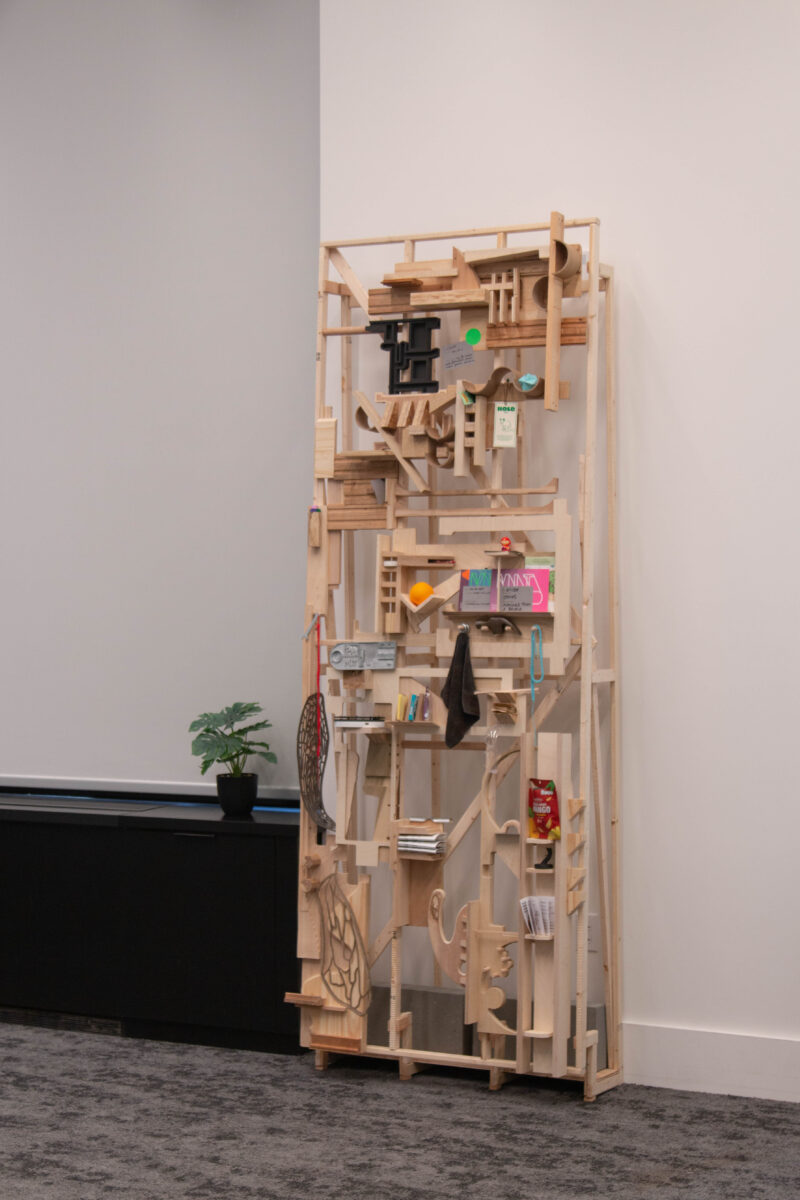
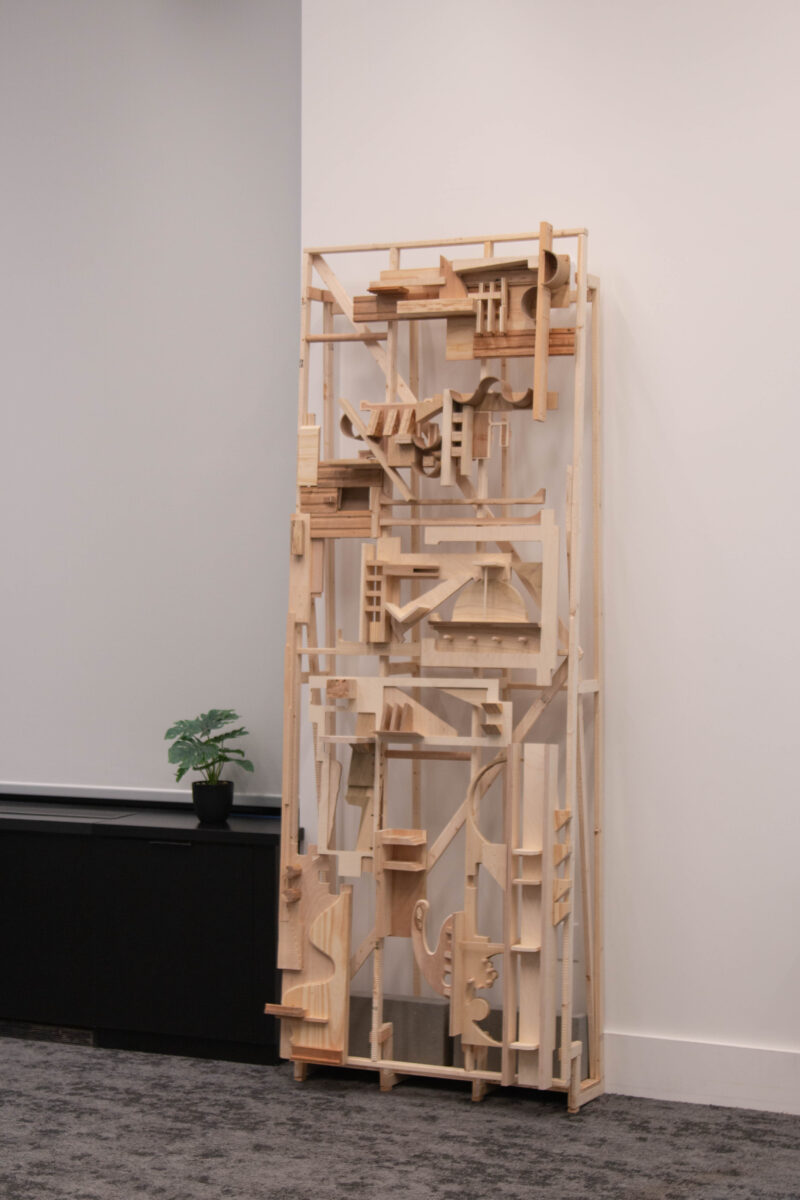
- The class culminated in groups of two or three teaming up to design an “intervention in the DEN,” or Dynamic Engagement Node (a multi-purpose room just off the main Infinite hallway, most often used as a study space for students with an awkward break between classes). I had the opportunity to work with an architecture grad student from the Harvard Graduate School of Design (GSD) to create “Useless Shelf”, a uniquely shaped structure using wood shop scraps meant to combat the liminality, staticness, and isolating quality of the space.
- 4.302 [Foundations in Art, Design, and Spatial Practices]
- Gloria and I are both substituting this requirement with other classes, as it conflicts with our respective schedules this semester. While neither of us (will) have first-hand experience with the class, from the description, it seems quite related to 4.110. Students practice viewing design critically and learn to communicate concepts of architecture, urban planning, and design by listening to guest lectures, viewing artistic exhibits and galleries, and visiting sites.
- 4.500 [Design Computation: Art, Objects, and Space]
- This class is notoriously known as “the chair class.” I’m under the impression that the professor and syllabus have changed since I took it three years ago, but the premise of the class is to teach students necessary modeling, computation, and fabrication skills from the ground up. When I took it, we had weekly assignments that built up our familiarity with tools like Rhino 3D, 3D printing, laser-cutting, etc., resulting in a life-sized chair made of planar modeling and half-inch thick plywood CNC-milled sheets.
- I took this class my freshman fall! Neglecting to heed the professor’s warning that it would be difficult to take the class as a first year (notably without any 3d modeling or fabrication experience), I ended up being the only freshman in the class. I do wish I had taken the class a bit later, like during my second or third year—I think I would have been a lot happier with and proud of my final chair, which still lives on in the living room of my apartment. That being said, taking this class so early was a great way to throw myself into the deep end, and learn how to learn new software, skills, and ways of thinking.

- 4.657 [Design: The History of Making Things]
- Gloria and I took this class together in our sophomore spring! The class looks closely at influential moments in design history, specifically as it relates to objects. Each lecture typically focused on one specific form of communication, environment, or object, and explored how it related to surrounding political, cultural, technological, or historical contexts. Each student got to pick one object to deep dive into, completing written and oral assignments following extensive research. I picked the first instant Polaroid camera, and Gloria chose the Vespa.
- 4.053 [Visual Communication Fundamentals]
- Having 4.053 as a required class for design majors is a relatively new change that took place somewhere during the 2024-2025 school year—our junior year. The department switched out the requirement for 4.022 [Introduction to Architectural Design Techniques]02 ”formerly , the second intro studio class that was jointly taken by Architecture and Design majors, with 4.053. Because this happened after I had already taken 4.022, I was able to count 4.022 as a required subject, and take 4.053 as an elective class instead. I’ll talk a little bit more about it below, in the electives section.
It’s worth talking a little bit about 4.022, since Gloria and I, along with many of our other friends in the department, took this class during our freshman spring.
- 4.022 [Introduction to Architectural Design Techniques]
- This class at large was focused on pushing us to interpret architecture in a variety of material ways—our instructor liked to call them “souvenirs.” In practice, we were each paired up and assigned a building on MIT’s campus—Simmons Hall, the Green Building, or the MIT Chapel—to become acquainted with over the course of the studio class.
- My partner, Claire C. ‘25 and I were assigned the Chapel, and together we explored the building through various resolutions. Through abstract spray painted pieces to high definition 3D powder printed structures to a collection of cast rockite models, we quickly gained a lot of experience in creating representations and their corresponding negatives/ formworks with fabrication tools.


3 – Four electives of your choice
Gloria:
Here’s where it gets fun! To complete the major, you pick 48 units (usually four classes) from three categories of courses: objects, information, and arts and experience.
- Objects is oriented around disciplines like product design, industrial design, and architecture, and about half of the qualifying classes in this category are actually from Course 2 (Mechanical Engineering).
- Information is concerned with interfaces, data visualization, and visual design in general, and also includes classes from Course 6 (Computer Science) like computer graphics and from CMS (Comparative Media Studies) like digital humanities.
- Arts and experience encompasses more of the fine arts and history world, including classes about artistic practice, critical theory, and mediums like sound art and interactive projection.
Of course, you’re welcome to take more than four classes, and classes outside of this list, if you want. Below are the four I’m using to fill this requirement:
- 4.s00 [Bad Translation: Expanded Typography and Publication]
- This was a special topics class, symbolized by the “s”! Course 4 offers many of these special subjects every semester, according to the lecturing faculty’s current interests, and they’re always niche and pretty interesting. 4.s00 specifically examined translation (both linguistically and more abstractly) through visual design, and we spent our time doing readings and working on a series of projects.
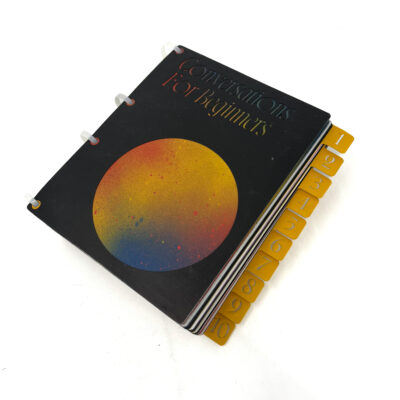
my final project, a book that “translated” conversational norms
- 11.C35 [Interactive Data Visualization and Society]
- This is also a Course 6 class, so I was able to double-count it for both of my majors. An introduction to making interactive data visualizations, as the name suggests: the class included both technical instruction and lectures on the design and impact of data graphics.
- 4.602 [Modern Art and Mass Culture]
- I just started this class this semester, so I can’t speak too much about it, but it’s going to be pretty reading and writing-heavy. I’m actually incredibly excited for it—I’ve wanted to take it ever since my freshman year.
- 4.341 [Intro to Photography and Related Media]
- Teresa and I both took this class (albeit in different semesters), so she’ll talk about it later below.


I also took/ will take some other classes, which I’ve described below. One of them isn’t technically within Course 4, but I’ve included it anyway because I feel like I lump it in thematically with my design coursework.
- 4.603 [Understanding Modern Architecture]
- I took this last semester, and it was one of my favorite classes I’ve taken at MIT. It was basically an intro to “modern” architecture, investigating what it means to be modern in the first place, and we did a lot of reading and looked at a lot of interesting projects. I wrote my final paper on corporate architecture and pattern-based control and an architect named Eero Saarinen [Introduction to Architectural Design Techniques]03 did you know that he designed the Bell Labs Holmdel Complex, which was the Lumon office building used in Severance :-0 also the MIT chapel lol !
- MAS.s63 [Recreating the Past]
- We learned about and then recreated important computational/ new media artworks from the past few decades in this class. It made me think a lot more critically and deeply about the relationship between computation and creativity, particularly in the early days of computers.
- 4.250 [Introduction to Urban Design & Development]
- An introduction to the field of urban design and development, mostly readings, pretty straightforward. More commonly known as 11.001 (joint course offering with the urban planning department).
- 4.501 [Tiny Fab: Advancements in Rapid Design and Fabrication of Small Homes]
- Teresa’s going to talk about this below!
My elective list is pretty scattered, but I think I tended to gravitate towards classes that related to my other academic interests in some way. For example, 11.C35 (data viz) and MAS.s63 (computational art) meshed nicely with my computer science coursework, while 4.602 and 4.603 (modernism!) tied in with my minor in comparative media studies.
Teresa:
These are the classes I am using to fulfill my elective requirements!
- 4.053 [Visual Communication Fundamentals]
- As mentioned earlier, when I was a first-year, 4.022 was a required class while 4.053 was an elective class for 4-B majors. The department was and still is actively working to find ways to distinguish Architecture from Design, and one of the ways they are achieving this is by designating 4.053 as a required class for design majors instead. This class, which I took during my sophomore fall, acts as a crash course in graphic design, specifically harnessing image and text to communicate ideas. Students use Adobe Illustrator, Photoshop, and InDesign to create posters and a final booklet.
- 21T.121 / 21M.601 [Drawing For Designers]
- Drawing for Designers is a HASS-A class that teaches students fundamental principles of fine arts and drawing, primarily through the medium of charcoal. People from all different departments and varying levels of art experience take this class, which makes it pretty fun and chill. I’ve heard the class syllabus can vary a bit from instructor to instructor, but in my class we practiced drawing still lifes, figure drawings, perspective drawings and portraits in three-hour weekly studio sessions. I took it during my sophomore spring, and it was a nice class for me to exercise some of my rusty traditional art muscles.


- 4.341 [Intro to Photography and Related Media]
- This class is under the Art, Culture, and Technology (ACT) Department. Students have access to a wide range of digital and film photography/filmography tools throughout the semester, which is broken into digital and film units. I took it junior fall and ended up learning a lot, from photography composition principles, to the history of photography, to leveraging ISO, aperture, and shutter speed to get desired results, to developing film strips in the dark room. Technically, I am using this class to replace my 4.302 requirement as touched on above, but I included it in the electives section as it is typically taken as a 4-B elective.


- 4.501 [Tiny Fab: Advancements in Rapid Design and Fabrication of Small Homes]
- Tiny Fab is taught by the same professor as 4.500—Gloria and I are really excited to be taking it this semester! Based on the first class, it seems to be an extension of a lot of the concepts from 4.500, but taking it to another level. Namely, 4.500 emphasized the use of digital tools—3D modeling, rendering, and plating software, digital drawing, etc.—and 4.501 will continue along that vein. By the end of the class, we’ll have learned how to use computational techniques to aid our digital fabrication and more easily scale our designs to help us produce a prototype of a package-able tiny home.
- 4.032 [Design Studio: Information Design and Visualization]
- I’m also taking this class this semester, so I don’t have much to say just yet! It’s an introductory class in data analysis and visualization, and using data as a storytelling and narrative tool. I don’t have a lot of experience with data analysis, but I think this class will tie in nicely with a Sloan class I’m taking, 15.076 [Analytics for a Better World].
4 – The design department upon closer inspection
Gloria:
I want to contextualize 4-B a bit more by contrasting it with Course 6 in a few ways. I’ll preface this by saying that I’m really happy with my experiences in both of these departments; they’re just different in a few fundamental ways and function to produce different types of students at the end of four years. I’m also minoring in CMS (Comparative Media Studies), as is Teresa, and she’ll talk about that department a bit later.
First, I think that compared with Course 6 and other engineering majors at MIT, Course 4 has a lot more interaction with the related graduate programs—the M.Arch (Masters of Architecture) and MCP (Masters of City Planning). Often, undergraduate and graduate architecture/ design students will be in the same classes, and students from the GSD over at Harvard also frequently cross-register at MIT. Thus, one aspect of Course 4 that I really enjoy is that I’ve met a lot more people outside of my year, program, and school, including visiting researchers, TAs, professors, and graduate students from all areas of the institute. In contrast, my experience in Course 6 has been a lot more siloed, with most of my peers being other members of the class of 2026. This is not necessarily a bad thing, just a natural consequence of the sheer number of people in Course 6: there are probably hundreds of computer science majors in my year alone. In contrast, there are four design majors and somewhere around ten architecture majors in the class of 2026, and the M.Arch and MCP programs probably have around 20-30 people per cohort each.
The small program size has its pros and cons. One pro is that there is more of a sense of community and camaraderie, especially when everyone is pulling late hours to finish up final projects. Design studios (classes that are oriented around hands-on projects) necessitate hands-on work, so everyone goes in person to makerspaces and workshops to get their assignments done. As a result, I end up seeing familiar faces often, even if I’m just chilling in N5204 a makerspace that hosts a lot of the design/architecture studios working on my laptop).
Similarly, another pro is that you can connect much more easily with faculty, including learning about their research interests, getting feedback from them on your personal and class projects, and just being exposed to current debates and pathways in the fields of design and architecture. Because studios are quite small, capping out at around 25 students and dipping to as low as three, they include one-on-one critique sessions with the professor as well as personalized assistance. In contrast, I’ve gone through many of my Course 6 classes without ever speaking to the professor face to face (partly because I haven’t gone out of my way to do so… this is definitely possible if you wish).
However, one con of the small program size is that there’s not much community knowledge in the student/ faculty body about design classes to take or professional opportunities and pathways within design. For example, in order to learn about studios you can take, which opportunities people recommend, etc., you have to do a bit of digging, including parsing through the course catalog, reaching out to alumni or upperclassmen, etc. Same thing for information about career pathways in design; there isn’t actually a career fair or the like for design internships and jobs. Much of the faculty comes from either an academia or architectural practice background, so they are still good resources, but targeted towards other spheres. In contrast, I feel like information about computer science classes and careers is extremely widely available among students, so much so that it can feel unavoidable sometimes (lol).
I would compare this aspect to, say, a school like CMU that has tightly targeted tracks in their design program for careers within HCI (human-computer interaction), UI/UX/product design, etc. In their classes, students still do theoretical or speculative design, but they also work on more “pre-professional” projects such as designing product packaging, conducting UI/UX case studies, and modeling/prototyping consumer products. The results of these assignments are often more immediately useful for recruiting for jobs and internships. In general, MIT’s program is a bit more focused on theory, breadth, and experimentation, with open-ended prompts. In my freshman and sophomore year, I remember feeling frustrated by this because I wanted to make things that were more pragmatic. In hindsight, though, I feel like the flexibility and theoretical backing of our classes actually gave me more breathing room to experiment, try different things, and really figure out what ideas I’m interested in, not just career paths.
But still one wonders—what happens after 4-B? There isn’t really a conventional path I can describe, as the variance is so high and the oldest design alumni graduated in 2022, just four years ago. What I’ll say is almost all of the ones I know of are now in different fields from each other. I know people who went on to a MFA program, who joined big consulting firms, who work on UI/ UX design at tech startups, and who entered PhD programs in design/architectural history. Thus, if I were to summarize my experience with the design program at MIT in one phrase, it would be something like “choose your own adventure.” The con of this is that you sort of have to make your own way instead of narrowing in on a defined path; the pro of this is that you can (potentially) leave with a stronger sense of and confidence in your interests and values. I’m extremely grateful to the program in this regard, and design has been such a defining component of my college experience.
Teresa:
It’s helpful to note that I am double majoring in 15-1 (Business Management) alongside 4-B, as well as minoring in Comparative Media Studies. Because I was a DesignPlus student my freshman year and felt like I had some good connections in the design major already, I decided to declare 15-1 as my primary major to make sure I had Course 15 advisors I could consult. I didn’t end up declaring 4-B as my secondary major until just last semester; as a result, my involvement with Course 4 has fluctuated on a semesterly basis depending on which requirements I was trying to knock out at the time.
Another consequence of this is that I wasn’t able to take nearly as many Course 4 classes as I wanted to. To be completely honest, I made a lot of course registration blunders in my first few semesters—taking unnecessary classes, having to retake classes, and generally not really knowing what path I wanted to head down. Thankfully, I was able to stretch many of my classes over multiple requirements, allowing me to double major and minor. For example, 15-1 allowed me to count two of my 4-B classes towards its concentration requirement, and many of my CMS classes are classes I was already planning to take for my 4-B electives.
This flexibility is a big reason why I came in wanting to study Design in the first place. Although I’d applied as several different majors to other schools, ranging from Education to Cognitive Science to Data Science, coming into MIT I was firmly sure I was going to study Design. This resolution is thanks, in large part, to taking DesignPlus as a first-year, which I have since continued to be involved in as a curriculum contributor and general space-inhabiter.
Moreover, I quite liked how ambiguous the Design requirements were. I thought it would pair really well with many of the other majors I was considering, as design is an implicit and foundational principle in every discipline. But nonetheless, my time at MIT is coming to an end. There are a handful of classes I will look at wistfully, and a whole lot of people and places I will miss sorely. Design at MIT naturally takes on a more STEM centric lens than perhaps at other institutions, and my four years here have inevitably shaped my view of design, what it can do, and what I can do. I’m in a place I honestly did not envision myself in four years ago, and I would do it all over again.
- Independent Activities Period, our January term between semesters back to text ↑
- formerly called 4.022 [Introduction to Design Techniques and Technologies back to text ↑
- did you know that he designed the Bell Labs Holmdel Complex, which was the Lumon office building used in Severance :-0 also the MIT chapel lol back to text ↑
- a makerspace that hosts a lot of the design/architecture studios back to text ↑