
Spring break Q&A: Part 2 by Jenny B. '25, MEng '26
where I FINALLY answer the rest of your questions :'D
Thanks to everyone who left questions in my Q&A! I haven’t gotten to the second half of the questions I got, so I’m going to answer the rest of those in a fresh post here.
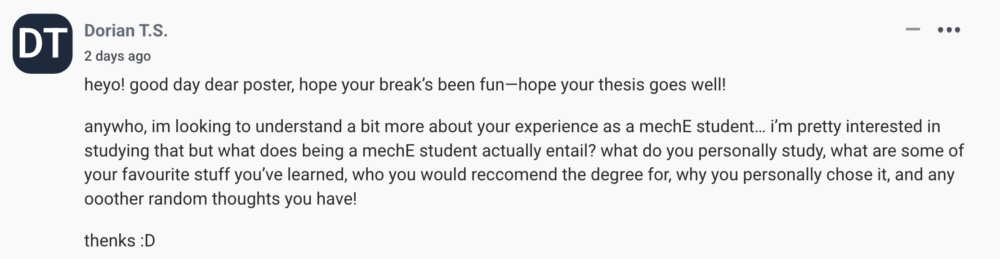
Unfortunately I’m not a MechE student 😔. I was heavily considering becoming a MechE at one point though — 2-A/6 specifically.
That being said, I’m doing my MEng thesis with a MechE lab here, even though the MEng program at MIT is largely with the EECS (Electrical Engineering & Computer Science) department. My thesis is going okay. My computer vision model isn’t doing as well as I hoped it would, but I think I still have interesting results to write about anyway.

Whatever your heart desires, as long as it’s legal.
A few ideas:
- Chill and play video games. (This is what I did most of the time lol)
- Work part-time. Become a tutor.
- Visit a place you haven’t been to before.
- Volunteer.
- Do an internship, if you’re that ambitious.
- Work on a project that you’ve always wanted to work on (building, painting, recording a rap album, whatever it is).
- If you’re one of those people who like to plan out everything for the next four years (I’m not), you could figure out what classes you want to take to fulfill your major of choice. But keep in mind that classes will change while you’re a student, and a class that you planned to take in sophomore year may no longer be available. Not to mention that it’s good to just keep your mind open about trying new classes.
- If there are required classes that you know you’ll have to take in freshman year, you could study ahead so you’ll be familiar with the material. If there’s something equivalent to ASEs (Advanced Standing Exams) that let you receive class credit by passing an exam, and you want to knock a few pre-reqs out of the way, that might be something looking into.
I don’t recommend burning yourself out or overworking yourself before you come to college though.
A lot

I won’t put every single class I’ve taken, but I’ll put the ones I remember right now:
TIER A:
- Advances in Computer Vision: Lowkey changed the last two years I’ve spent at MIT. Computer vision ended up being my favorite area of machine learning that I’ve worked with, and it influenced the kinds of projects I’ve worked on since. There’s just something really fun about trying to get robots/programs to make sense of what they’re seeing. For responsible applications though, not including surveillance crap, because that is scary and not fun.
- Writing and Reading Short Stories: The first creative writing class I’ve ever taken in my life. I was fortunate to have a good professor who mediated the workshops pretty well in a way that was beginner-friendly but still constructive. I got a solid toolkit of skills that I use when I write fiction on my own (e.g. assessing plot, thinking about characters), and I got over my fear of workshops when I found out that I actually really enjoy them.
TIER B:
- Robotic Manipulation: My one robotics-related course that I took at MIT. I enjoyed the content a lot, because I usually enjoy a class better when I can directly use the content in an application, instead of learning it in a theoretical vacuum. This is only in B-tier because we had to use the Python version of Drake, and it wasn’t well-documented. Nora and I made a program that got a virtual robotic arm to autonomously stack cups into a pyramid. It’s one of the rare class projects I’ve worked on that actually did what it was supposed to do.
- Critical Internet Studies: I had a great professor, and the curriculum was thoughtfully organized. The class readings got me to reframe some of the perceptions I’ve had about internet safety, surveillance, and the work that goes into maintaining and curating online spaces, all of which are very apt to think about in this day and age.
TIER C:
- Introduction to Statistical Data Analysis: It was well taught, and the teaching staff knew what they were doing. I just thought the content itself was boring. But there was one project about NBA statistics that was pretty interesting.
- Fundamentals of Programming: On one hand, it was a proper introduction to Python programming, and my skill level grew a lot in that one semester. On the other hand, it was a lot of work.
TIER D:
- All the Science Core GIRs: 8.02 (Electricity and Magnetism) was the most interesting to me out of all of these. I still feel a little nostalgic about the biology class though, given that I was a huge biology-head in high school.
- Introduction to Probability: The most exposure I had to probability before MIT was stuff like, “If there are 3 red marbles and 5 blue marbles in a bag, and you draw two marbles, what’s the chance that both of them are red?” So this class was already a big hurdle for me, if it wasn’t for the fact that the professor teaching that semester also wasn’t a good lecturer. This doesn’t quite belong in Tier F, because the concepts and terminology ended up being pretty useful in the AI/ML classes that I later took, but I’m still bitter about how it was taught.
TIER F:
- Introduction to Algorithms: Nothing about this class brought me joy.

I barely even knew how to code before I came to MIT, and I hadn’t won any international olympiads. They could help your application, but they’re definitely not all to it.

For the rest of my life, no matter how old I get, I know I want to make art.01 Not AI-generated slop, just to get the record straight in this day and age. Corny as it sounds, I feel it in my soul. Probably writing novels, although it’d be really epic if I get to write and/or illustrate a comic. Maybe make short films, if I get a laptop that doesn’t lag whenever I use video editing software.
Because I want to hoard as much creative freedom to myself that I can get, I decided not to go with art and writing as my main career. I’ve always liked science and engineering a lot (for as long as I’ve liked art),02 It started when I was four years old and watched Jurassic Park. Kickstarted my fascination with movie-making, engineering with the animatronics and stuff, biology, character design, writing. I probably shouldn't have watched Jurassic Park that young, but whatever. and I could see myself working a day job in that general direction. So it made sense for me to dedicate my college education to STEM, and I was lucky to end up at MIT for it. I also got to work on several artistic projects and meet other art/writing enthusiasts while I’ve been here, so it’s a win-win!

Internships: There isn’t really an overarching goal, I guess? If you want to aim for a big name internship then go for it. In my honest opinion, no company is worth getting into “at all costs.” There are so many opportunities out there for personal growth and impressive projects, and you don’t necessarily need to get a prestigious name to get a good opportunity.
Imposter syndrome: I guess it depends on your temperament. Imposter syndrome hasn’t disappeared for me, and I feel like it never really will. It’s a side effect of holding myself to high standards, I guess.
- Not AI-generated slop, just to get the record straight in this day and age. back to text ↑
- It started when I was four years old and watched Jurassic Park. Kickstarted my fascination with movie-making, engineering with the animatronics and stuff, biology, character design, writing. I probably shouldn't have watched Jurassic Park that young, but whatever. back to text ↑