
last week, i failed at a jigsaw puzzle and knot theory by Aiden H. '28
and some fears about returning
This past week, I made the mistake of trying to have a Sunday morning brunch, no reservation. After driving 20 minutes to the best brunch place around with my mom, sister, and girlfriend, none of us were surprised to learn we would have to wait at minimum another 20 before being sat.
And so began the saga.
To kill the time we rounded the corner to a cutesy puzzle and games store. After messing around with Lego flowers, Calico critters, and petting the live bunny they have randomly hanging around, I stumbled upon this beauty:

Priced at a relatively cheap $25, I thought a 1000 piece puzzle might be a little bit of a stretch considering I was leaving Colorado and heading back to MIT at 5 AM Wednesday morning but bought it anyway. Besides, at the point that you’re doing a puzzle, how much of a difference is 500 versus 1000 pieces? Also it’s a pretty distinctive and bright puzzle, so the pieces should be pretty easy to delineate.
Wrong.
I have a bad history with jigsaw puzzles. I always turn to them in a time of productivity crisis (see: COVID lockdown and summer breaks) when I feel bad if I just rot on my phone all day, but I don’t necessarily want to do actually productive work. A similar feeling is reached by reading excessive amounts or tracking my steps.
So what came upon me to believe that my girlfriend and I could crank out a 1000 piece puzzle in 48 hours? Narcissism and amnesia.
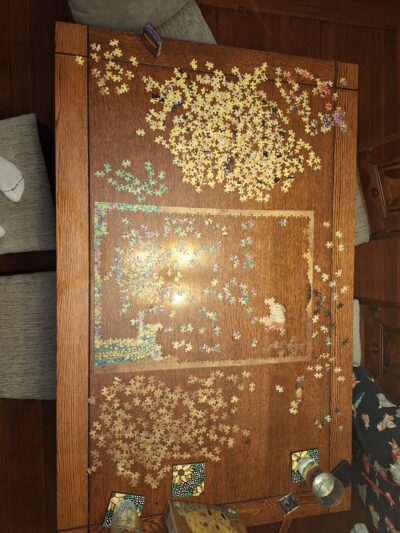
We started the first day strong enough, cranking out the edges in 1.5 New Girl episodes/45 minutes. Then disaster hit. I made the awful suggestion of starting at the bottom because the flowers were more distinctive than the mass of yellow above. A whopping six hours into the puzzle, we had only gotten this far:
The next day was much of the same, spending hours upon hours trying to speed run this god-forsaken puzzle, only to be here upon midnight:
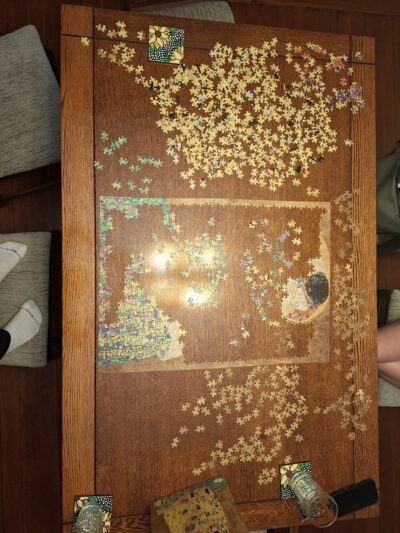
With less than 24 hours left before my flight to Boston, we gave up on the puzzle.

***
My return to campus was as normal as ever. I picked up all of my summer storage boxes and said hi to friends as I made my way down the hall to my room, only to be faced with puzzle number two: untangling my fairy lights.
Like anyone under 30 with questionable taste, I have fairy string lights hung up around my dorm room to offset the harsh Walmart-brand overhead lighting that graces MIT dorms. Amongst the rush of packing and simultaneously half-passing my finals in the spring, my past self decided the best decision at the time was to rip-them-off-the-wall-and-shove-them-into-a-box-as-fast-as-possible, which admittedly did not help present-day Aiden when trying to untangle said lights.
I sat on my floor for genuinely an hour and a half trying both possible forms of detangling (trying to methodologically follow each strand and untangle one by one, and flailing it around until it miraculously untangles), of which neither were successful.
Sitting there angry and sweating, I noticed that my tangle of fairy lights looks a lot like a mathematical knot (and I guess a literal one), which is something I know nothing about but have always been interested in. So after 30 minutes of intense Wikipedia-ing and watching simplified YouTube videos, I learned my first fact about knot theory: unknotting numbers. Apparently the unknotting number is the minimum number of moves01 Of which I think only some are valid? Can someone tell me if this definition means the minimum number of the three Reidemeister moves? it takes to turn a knot into an unknot, which is just math-ese for circle.02 but circle is also math so what the hell I also learned/AI-overviewed some constraints, learning that the unknotting number of any knots is always less than half the knot’s crossing number.
But wait wait wait, as learning too much would ruin my night and prove me a dumbass once again. Technically in math a knot must be “closed” so that all the end are connected, which is, in all fair, completely ridiculous. Shoelaces? Not a knot. Rope? Not a knot. Ribbons? Not a knot. A circle? Definitely a knot but again not because it’s an unknot. (side note but Dr. Seuss would love knot theory).
My fairy lights? Not a knot.
Looking at my fairy lights again, I felt equally as stuck and now also bad at math. But knot or not,03 see what i did there I became convinced by their complexity to have at least a not-a-(un)knotting number of at least 74.
I sat down, analyzed it from all sides like those Rubiks cube guys, and pulled one string from the middle. I kid you not, in the most this-whole-thing-was-scripted way, the entire thing of lights came undone across my lap and was able to string out perfectly across my floor.
It turns out it had an “unknotting” number of 1. Like always, I made everything too complicated.
But look at that, I solved a puzzle.
***
In a very loose metaphor that is definitely not a stretch, I can’t help but feel like these experiences were premonitions on the coming semester.04 I’ve noticed that whenever I have something big/notable/minorly important coming up, I take everything around me as some sort of sign. I have no idea why.
Going into freshman year, I had the normal anxieties about moving to college. Most of these were social; will I have friends, like the dining halls, have enough personal space, etc. etc.? My concerns were solely about being able to survive and thrive in the lived experience of being at MIT. After a less-than-stellar freshman experience, I returned to sophomore year fearing things that I had felt become true: isolation, boredom, and stress at college.
Returning for a third time, though, I find that my nerves have been exacerbated but shifted. For the first time coming back, I feel not overwhelmed by the experinece of going to college, but my going to MIT. I feel unable to perform at a level that makes me feel confident–whether it be getting things done on time or literally being able to understand what is happening around me. I’m terrified of actual failure.
This is a pretty common sentiment at MIT. Call it imposter syndrome or whatever, but actually having a taste for MIT makes me feel less like an imposter and more like someone who just can’t handle it all again. I’m not anxiously dreaming up a difficulty in workload, I know it exists.
This is also not a common sentiment at MIT. Most people come to MIT and have an adjustment period where they learn school can be actually hard, but they get over this feeling as time goes on, and eventually as an upperclassman it just feels like school and not battling a dragon. I feel like I’m Benjamin Button-ing through these emotions. Freshman year academics? Totally fine and I would encourage you not to be stressed. Junior year? I’d shit my pants.
But then again everything is always a happy-ish medium. I will almost definitely be stressed this semester. I will also not experience anything I haven’t survived before. Everything will be manageable, I just need to find a way to manage myself going into it.
I guess only time will tell?
- Of which I think only some are valid? Can someone tell me if this definition means the minimum number of the three Reidemeister moves? back to text ↑
- but circle is also math so what the hell back to text ↑
- see what i did there back to text ↑
- I’ve noticed that whenever I have something big/notable/minorly important coming up, I take everything around me as some sort of sign. I have no idea why. back to text ↑