Beaches and Bioreactors by Nicholas R. '29
summer is gone and I'm trying to move on
We’re over two weeks into the school year now, yet my brain has hardly registered the fact that summer is over. Following all the hustle of Orientation01 I was an orientation leader for silver team this year. Go silver! , rush week02 Rush is the week after first-year orientation, when all of the frats and sororities host recruitment events for students interested in joining Greek life. , and the end of my UROP, the start of classes felt like an afterthought. Now that afterthought is rearing its head in the form of several problem sets with very imminent deadlines.
In hopes of curing my mental jet lag, I want to reflect a bit on my summer because it was a great one. I did many things, including:
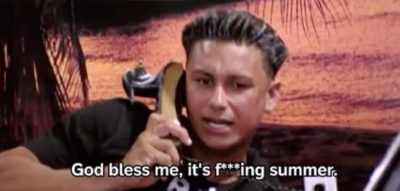
- Watching the first four seasons of Jersey Shore03 Truly one of the greatest pieces of media. A cultural document of its time.
- Learning how to play guitar (sort of, I’m still not very good)
- Hiking at Acadia National Park
- UROPing
- Working on my class’s Brass Rat design
- …and, arguably most importantly, applying to be an Admissions blogger!
June
The opportunity for my UROP somehow fell into my lap. By the end of last spring semester, I had resigned myself to spending the summer back home after no luck finding research and missing the deadline for direct funding.04 The fall deadline has already passed, but the spring deadline this year is February 2nd. You're welcome. I was looking forward to being home, but I couldn’t shake the feeling that I was missing out as many of my MIT friends headed off to internships, research labs, and MISTI programs abroad. Then, seemingly out of nowhere, I got an email from the ChemE05 Chemical Engineering department looking for an undergrad to help with curriculum development for 10.28,06 Chemical-Biological Engineering Laboratory an upperclassman lab course focused on bioprocess engineering. I applied, tried my best to sound casual despite desperately wanting the position, and, as you could’ve guessed, got the job.
My UROP didn’t start until the 15th, so I had a couple weeks to hang around back home. Those couple weeks were remarkably unremarkable: I slept in almost every day, played video games, went to the beach, and relished the fact that I had unstructured time to be bored for once.
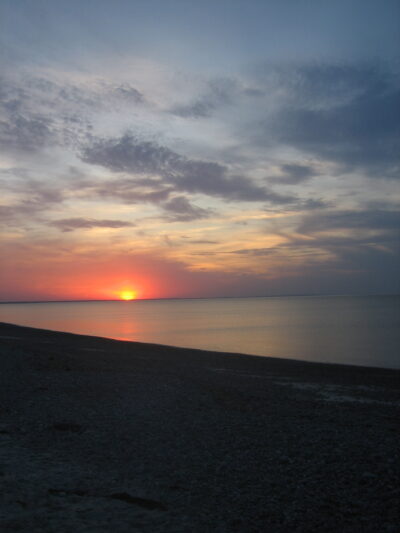
A sunset at Sandy Neck Beach, Cape Cod.
Once my UROP started, I was caught between worlds. During the weekdays, I stayed at my fraternity, Zeta Psi, in Boston while I worked on campus. On most Fridays, I threw my backpack in my car and drove two hours from Cambridge to my home of Cape Cod. The following Sunday, I did it in reverse. While the ping-ponging got tiring, it was worth it to see my family and hometown friends. Last summer, I was away at MIT for Interphase,07 Interphase is a two-year scholar enrichment program that includes an eight-week summer session, where incoming first-years take classes in calculus, physics, chemistry, and writing. It is designed to help build community and ease the transition to MIT. and the one prior I was in Indiana for the Summer Science Program.08 The Summer Science Program (SSP) is a five-week residential STEM program where high school juniors conduct hands-on, collaborative research on college campuses. My program was in biochemistry at Purdue University! Because of this trend, my friends loved to joke that I hate Cape Cod summers, so I made it a point to be home whenever I could.
June also marked the start of weekly meetings for RingComm ’29.09 The Ring Committee is a group of 12 students selected to design their year's class ring, also known as the Brass Rat. Students receive their rings at the end of their sophomore year during Ring Delivery. I’m one of the artists on the committee, meaning a good chunk of my summer was spent working on our Brass Rat design. I will most definitely write a blog about this in the future (after Ring Premiere10 The event where the ring design is revealed to the rest of the class. ), but these are all the details I’ll share for now.
July
Soon enough, July was here. I received a reminder from my phone, one that I’d set months in advance, notifying me that the application to be an Admissions blogger had opened. In high school, I spent countless nights picturing (or, more accurately, manifesting) myself at this school, and the blogs gave me a glimpse into what that could look like. Regrettably, I’d forgotten to apply last year, so this go-around I was prepared.
Throughout the month, I chipped away at the application which, unsurprisingly, involved lots of writing; the excerpt below is from one of the sample blogs I wrote for it.
It’s crazy—and frankly upsetting—to think that, as I write this, summer is more than halfway through. My mom always says summer is practically over once the Fourth of July passes. And she’s sort of right, at least for where I’m from; Cape Cod is chock-full of tourists around this time of year, but as August nears and the school year
threatens to returngraciously approaches, the crowds begin to disappear. For a few weeks after this drop-off, we get what I call a “local summer,” when the hustle and bustle settles to a calmer hum and the weather is still as nice as it gets.I’ll mostly be away for this year’s local summer, so I’ve been trying even harder to soak up the season before it’s gone. In fact, I’ve been soaking up many new things this summer, including my first-ever UROP!
And I certainly was soaking it up. I got to work alongside the amazing Dr. Joshua Abraham, who is instructing 10.28 this fall. During the first half of the summer, most of our work involved preparing the new lab space, as the class’s teaching lab was being moved from Building 66 to E18. After organizing equipment and testing instruments, we shifted our focus to operating one of the more complicated pieces of equipment: the bioreactor.
Bioreactors are vessels that allow us to grow bacteria and other microorganisms with precise control over factors like temperature, pH, oxygen levels, and mixing. Over the next few weeks—across many runs and different batch modes—we assembled, disassembled, tested, and troubleshot all six of the bioreactors in the lab (one for each team of students). To test them, we grew different strains of E. coli and used them to produce three enzymes of interest: alpha-amylase, laccase, and lipase. These enzymes have a wide range of industrial applications, including processes involved in paper production, dye removal, and detergents.
Earlier in the summer, Dr. Abraham and I selected three genetic constructs11 Also known as vectors. that encode these enzymes. After purchasing the constructs from the company GenScript, we introduced them into our E. coli cells, allowing the bacteria to act as tiny factories that produce the enzymes.


August
After we had the bioreactors mostly figured out, we moved on to writing and verifying protocols for downstream purification and characterization. In less jargon-y terms, we purified our cell culture samples so that they (hopefully) only contained our enzymes of interest; we then ran a set of tests, or assays, to determine their activity. I’ll resist my course 10B12 Biological-Chemical Engineering urge to yap in writing about all the cool wet lab techniques I got to practice, however I will include a picture of a very aesthetically pleasing standard curve from one of the enzyme assays.
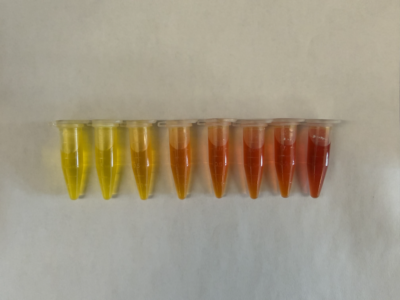
The assays we tested were colorimetric, so as the enzymes consumed their substrate, the reaction produced changes in color that could be measured via spectrophotometer.
Near the middle of August, a few of my hometown friends and I went camping in Acadia National Park, Maine. We woke up at 2:30 AM the first morning (or should I say night?) to go on a hike up Cadillac Mountain; we’d heard that at its summit, we’d be able to see the earliest sunrise in the continental United States. Despite our two hours of sleep, we drove to the location and began making our way up the mountain. As we neared our destination, the dense, rocky landscape opened up, as if the mountain itself was welcoming us. When we finally reached the top, we searched for a nice spot to watch the sunrise—a bright pinkish-orange that slowly crept up from the horizon, illuminating the ocean and the smaller islands surrounding Acadia.
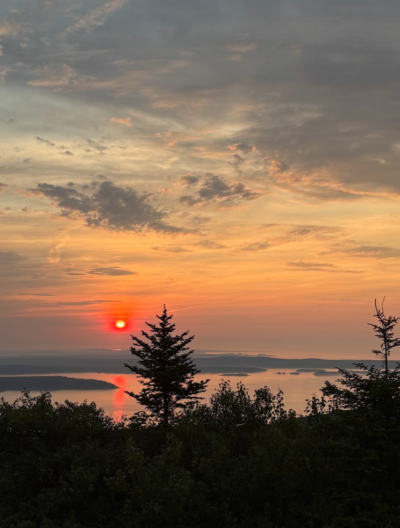
The sunrise.
Shortly after our first excursion, we were met with a torrential downpour which at one point flooded our tents (it didn’t help that we forgot to put on the rain covers). Even with the soggy conditions, we went on plenty more side quests to explore the area, making the best of our remaining time there.


Following my trip to Acadia, the rest of my UROP focused on troubleshooting the CRISPR section13 The goal was to have students integrate Green Fluorescent Protein (GFP) expression into a specific site on the <em>E. coli</em> chromosome using CRISPR-Cas9 genome editing with λ-Red recombineering. of the course, drafting pre-lab assignments, and polishing up protocols in the lab manual. One of my favorite parts of this UROP was getting to learn through the lens of curriculum development, optimizing procedures and experiments for a teaching setting. It was also rewarding to know that my efforts were being put towards something tangible. Now I can say that I, at least in some small way, helped design a class at MIT!
Most of all, though, I feel lucky to have gotten such an opportunity so last minute. I remember feeling very anxious about not doing something “resume-able” this summer, yet somehow it worked itself out. And as much as I loved my UROP, I equally treasured the time I got to spend at home with friends and family, the time I got to spend at the beach letting my worries melt away like footprints on a shoreline, and the time I got to spend doing nothing at all.
As I return to the turbulence of the school year, times like those anchor me.
- I was an orientation leader for silver team this year. Go silver! back to text ↑
- Rush is the week after first-year orientation, when all of the frats and sororities host recruitment events for students interested in joining Greek life. back to text ↑
- Truly one of the greatest pieces of media. A cultural document of its time. back to text ↑
- The fall deadline has already passed, but the spring deadline this year is February 2nd. You're welcome. back to text ↑
- Chemical Engineering back to text ↑
- Chemical-Biological Engineering Laboratory back to text ↑
- Interphase is a two-year scholar enrichment program that includes an eight-week summer session, where incoming first-years take classes in calculus, physics, chemistry, and writing. It is designed to help build community and ease the transition to MIT. back to text ↑
- The Summer Science Program (SSP) is a five-week residential STEM program where high school juniors conduct hands-on, collaborative research on college campuses. My program was in biochemistry at Purdue University! back to text ↑
- The Ring Committee is a group of 12 students selected to design their year's class ring, also known as the Brass Rat. Students receive their rings at the end of their sophomore year during Ring Delivery. back to text ↑
- The event where the ring design is revealed to the rest of the class. back to text ↑
- Also known as vectors. back to text ↑
- Biological-Chemical Engineering back to text ↑
- The goal was to have students integrate Green Fluorescent Protein (GFP) expression into a specific site on the E. coli chromosome using CRISPR-Cas9 genome editing with λ-Red recombineering. back to text ↑