
trying to find poetry under calculus by Joy X. '29
mit museum and constrained writing

It’s October–which means it’s been almost two years since my first visit to MIT. I visited MIT the first time in October 2024 and loved it, which is part of the reason I chose to be here today. And one of my strongest first memories of this place—the one that cemented the nerdy MIT culture in my mind–was the MIT Museum.
It was different from any other museum I’ve seen. I found almost every exhibit interesting (which is not typical of me in normal museums, where I lose interest and breeze past the exhibits). They had an exhibit on the dangers of AI (pretty relevant today tbh), a whole section dedicated to the inventions made from MIT (one that stood out to me the most was a keyboard algorithm that tracked people’s finger movements to detect Parkinson’s disease), a pink chicken, a taxidermied ‘mermaid’ in a glass case (…which was quite frightening), a juggling machine, and a bunch of other cool things!


If you like STEM and/or weird things, I highly encourage you to visit–to this day, I still go to the MIT Museum area (there’s a great cafe next to it!) to do my problem sets and so I can somehow absorb the ingenuity emanating off of the exhibits inside.

But my favorite thing I saw was an exhibit that let you write poems to the next person that sees the exhibit with random (but somewhat above average in nerdiness/mit-esqueness) words.
When I got there, the message that the previous person left me was this:
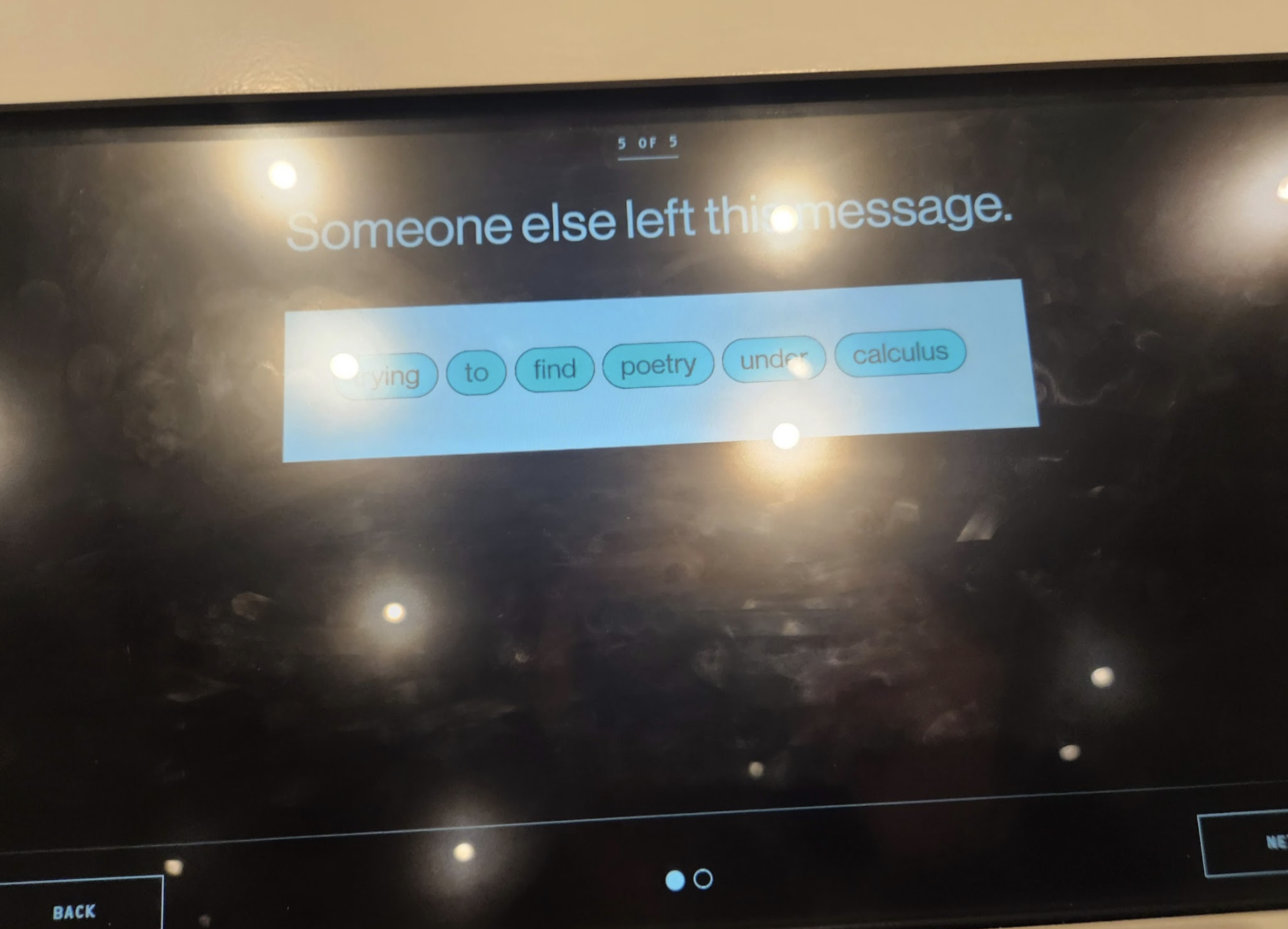
trying to find poetry under calculus.
I LOVE CALCULUS!! AND POETRY WITH CALCULUS!!
Calculus was very definitely my favorite class in high school, not only because it was the first math class that felt like it wasn’t just memorizing formulas, but also because I loved my teacher (shoutout Ms. Kalbag–most goated high school teacher I’ve had, tbh) and classmates. Our class was small, with 12ish people, so we were especially close-knit for a class in a public high school, and many shenanigans were pulled. I have so many stories from that class. 01 My juggling journey started in that class–I learned a bunch of pen spinning tricks (did you know pen spinning is a type of contact juggling?) that year, and hence dropped my pen many times in that class. For some reason my classmates found this really funny (and my teacher found this very annoying) and started a tally of how many times I dropped my pen. Apparently my record is >200 in a month.
One thing we started was the tradition of trying to make our teacher laugh when grading our exams by writing math-related jokes in the margins of our tests. Usually it was cheesy jokes like “I see you have graph paper…you must be plotting something evil with those weapons of math instruction!”.
At this time, I was also a fan of reading David Morin’s physics textbooks. I highly recommend them–David Morin is the GOAT of physics textbooks (I think he still teaches at Harvard, so maybe I can have the chance to meet him someday and get his autograph :O). Not only is his writing style super clear and engaging, but his textbooks also have limericks in them!
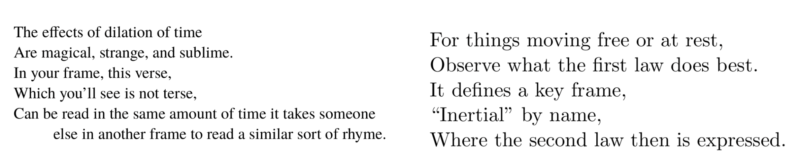
Some limerick samples–the first one is from Special Relativity for the Enthusiastic Beginner, and the second one is from Introductory Classical Mechanics, both by David Morin.
I was so inspired by these demonstrations-by-limerick and I thought it would be cool if I could write a proof on my calculus final exam in poem form. Our teacher had told us that we needed to know how to prove the quotient rule, so that was a natural choice of proof.
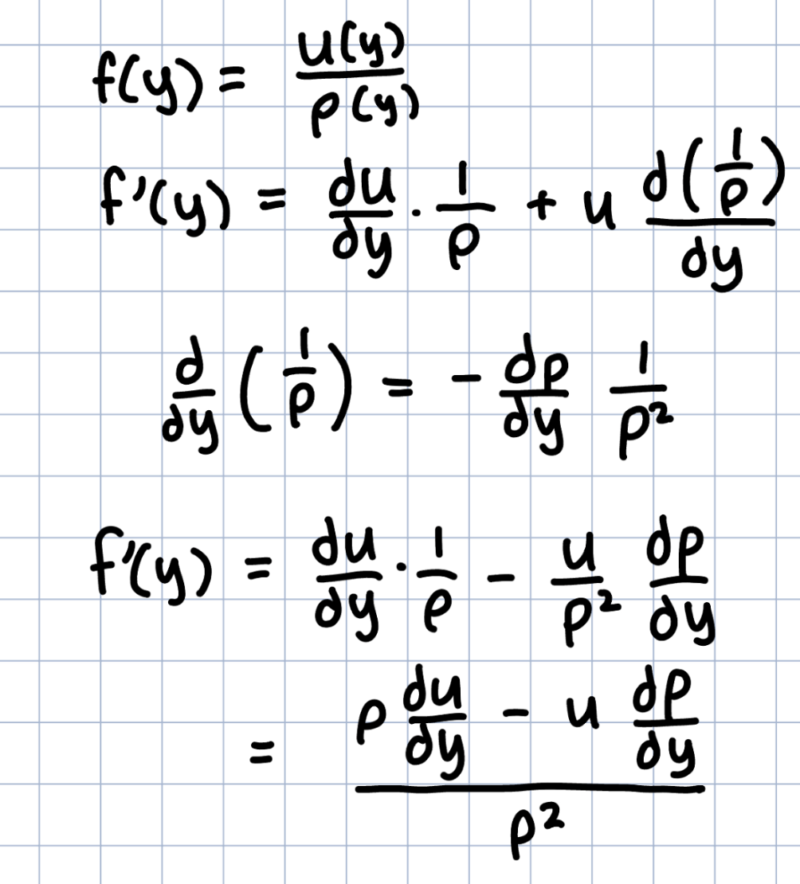
As a reminder, the quotient rule says that if we have a function that can be written as the quotient of two other functions, the derivative of that function looks like this:
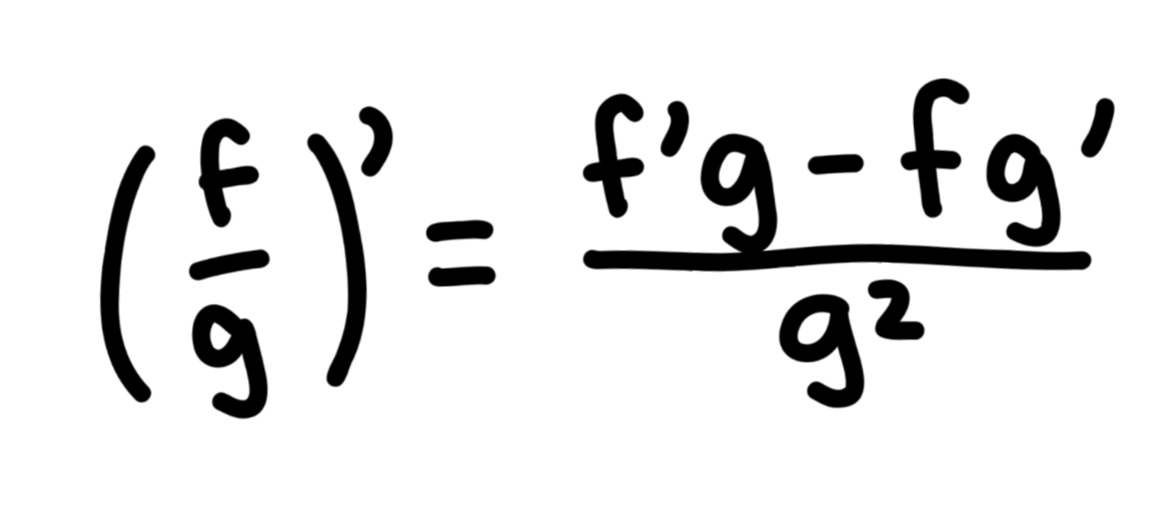
I always forget which way the negative sign goes…
But what format of poem would I use? God forbid trying to prove it in 17 syllables, so haiku was off the table. A limerick was still too short to cram the proof into. Aha–a Shakespearean Sonnet!
I’d never read actually read Shakespeare beyond acting in a small school production of A Midsummer’s Night’s Dream in sixth grade (and it was very much a shortened version, but still a decent length for my sixth grade self’s memory), but “Shakespeare” was the most unrelated thing to calculus I could think of, and so writing a proof in Shakespearean Sonnet form would maximize hilarity.
But first, I needed to find out what a Shakespearean sonnet was. A quick Google search gave me the structure: iambic pentameter in an abab cdcd efef gg rhyme scheme.
…Okayyyy, I still didn’t know what an “iambic pentameter” is. Another Google search showed me that it’s a type of rhythm that goes “da DUM da DUM da DUM da DUM da DUM” (one ‘da DUM’ makes an iamb, and five of them make pentameter!). Here, a “da” is an unstressed syllable and a “DUM” is a stressed syllable.
Here’s an excerpt of Shakespeare’s Sonnet 12, which has iambic pentameter, as a demonstration:
When I do count the clock that tells the time
(hmm that seems a bit redundant, but who am I to judge Shakespeare? Maybe in his time, the clocks could tell the temperature too.)
The bolded syllables are the stressed syllables. If you say it out loud, it sounds very nice and rhythmic, like a heartbeat!
After culturing myself on Shakespeare, I sat down to write. I knew I wanted the last couplet (the two lines that have the gg rhyme scheme) to conclude my proof with some kind of Q.E.D. (a mathematician’s “ta-da, i did it!”. it stands for some fancy latin thing), so I started with that. It was hard figuring out the iambic pentameter—it took a couple minutes per line of me repeating it very slowly, putting stress in different places, and trying to hear if that sounded natural. I still don’t know how people write meter in poetry.
The three quatrains (stanzas with four lines each) were even trickier to get right. I spent three hours fiddling with my lines, juggling the rhyme scheme, iambic pentameter, and of course, making sure it was mathematically valid. Midway through my composing, I realized that my initial variable choice of the familiar x and y could not work with the rhyme scheme—too few words rhymed with ‘x’:
X, although not complex, did more than perplex: the rhyme objects!
Sorry.
Although it saddened me to have to rework a full two quatrains, I knew I had to make the sacrifice. In order to use poetry to do calculus, I had to use calculus to do poetry: I applied the familiar technique of changing the variables (you might call it u-substitution). Instead of x, I switched to rho, and lo!
It worked. (Eventually).
Then came another hour of constantly tabbing over to RhymeZone, whispering lines to myself, and digitally thumbing through the thesaurus…and ta-da, I did it! (or should I say, Q.E.D.?)
Here’s the final product, as written on the back of my final (sadly, our teacher lied and there was no ‘prove the quotient rule’ question, so I was never able to see how my proof held up, points-wise):
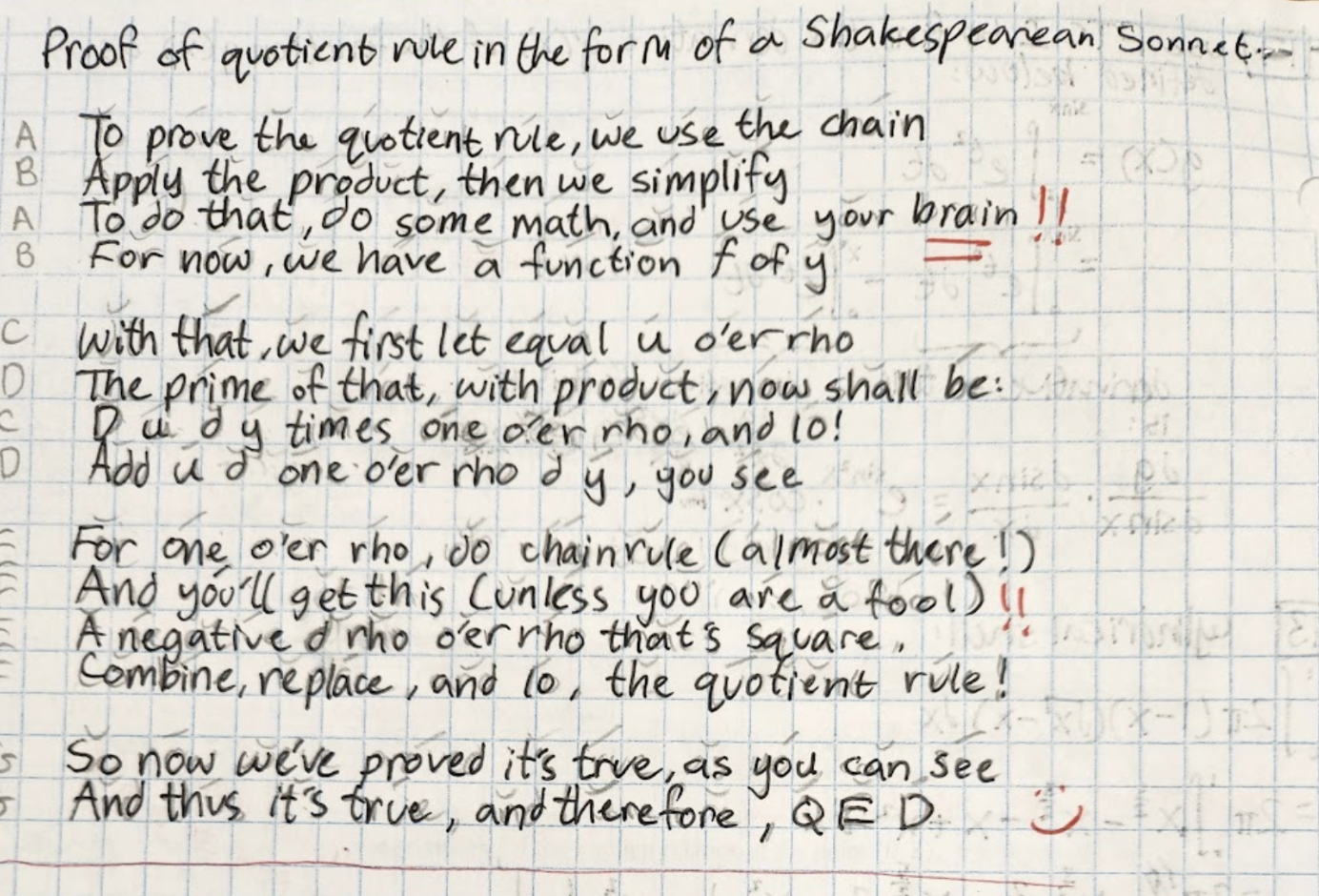
To prove the quotient rule, we use the chain
Apply the product, then we simplify
To do that, do some math, and use your brain
For now, We have a function f of y.
With that, We first let equal u o’er rho
The prime of that, with product, now shall be
D u d y times rho inverse, and lo
Add u d one oe’r rho d y, you see.
For one o’er rho, do chain rule (almost there!)
And you’ll get this (unless you are a fool)
The minus prime of rho o’er rho that’s square
Combine, replace, and lo, the quotient rule!
So now we’ve proved it’s true, as you can see
And thus it’s proven, and therefore, Q E D.
In regular form, the proof looks like this:
So there you go! The quotient rule, proved in Shakespearean Sonnet form. Looking back, it was actually a very fun three hours–and I’m surprised it only took me three hours. I’ve realized that I’m a big fan of these constrained writing challenges. 02 ...in fact, all the writing that I do is constrained! ...by writer's block 😅
Perhaps next time I’ll write something in pilish 03 A form of constrained writing where the first word is 3 letters long, the second is 1 letter, the third is 4 letters, and so on and so forth according to the digits of Pi. Apparently, Edgar Allan Poe's <em>The Raven </em>has been rewritten in pilish (search up <em>Poe, E. Near a Raven</em>), which is seriously impressive to me. for Pi Day, or in a post without the letter e 04 I actually own a book without any e’s in it—<i>A Void </i>by Georges Perec. I’ve read only the first few chapters, but surprisingly it is not <i>completely </i>incomprehensible—it actually reads sort of smoothly, if you don’t mind sentences that span half a page. for e day (that’s February seventy-first).

05 credit to Grace L. '30 for helping me figure out how to resize my decorative images :)
- My juggling journey started in that class–I learned a bunch of pen spinning tricks (did you know pen spinning is a type of contact juggling?) that year, and hence dropped my pen many times in that class. For some reason my classmates found this really funny (and my teacher found this very annoying) and started a tally of how many times I dropped my pen. Apparently my record is >200 in a month. back to text ↑
- ...in fact, all the writing that I do is constrained! ...by writer's block 😅 back to text ↑
- A form of constrained writing where the first word is 3 letters long, the second is 1 letter, the third is 4 letters, and so on and so forth according to the digits of Pi. Apparently, Edgar Allan Poe's The Raven has been rewritten in pilish (search up Poe, E. Near a Raven), which is seriously impressive to me. back to text ↑
- I actually own a book without any e’s in it—A Void by Georges Perec. I’ve read only the first few chapters, but surprisingly it is not completely incomprehensible—it actually reads sort of smoothly, if you don’t mind sentences that span half a page. back to text ↑
- credit to Grace L. '30 for helping me figure out how to resize my decorative images :) back to text ↑