
The Sophomore Slump by Nicholas R. '29
some notes on (and from) my classes this semester
I find “sophomore slump” to be quite the interesting term. For one, it gets thrown around in a lot of different contexts—from music and visual media to sports and, of course, academics. I’ve always wondered how this phenomenon, which sounds fairly specific, pervades such a variety of spaces.
Just over a month in to my sophomore year, I’m starting to understand (and, crucially, experience) how it does at MIT. A couple obvious culprits to point out: there’s no longer the cushion of P/NR and ABC/NR,01 First-years have a unique grading system. During fall semester, classes are graded on a Pass/No Record basis: a passing grade of C- or above will show up as 'P' on a transcript, while a failing grade won't show up at all. During spring semester, letter grades are given for any passed classes, but the No Record policy still applies. a true blessing for frosh. Additionally, most sophomores begin transitioning from the GIRs02 General Institute Requirements and other introductory courses to major-specific, often harder, courses.
While I’d say that my classes this semester are harder than last spring, I feel like the comparison is heightened because I never really found proper footing. The start of this school year felt like a blur, driven by the hecticness of Orientation and, much more so, Rush week03 Rush is the week after first-year orientation, when all of the frats and sororities host recruitment events for students interested in joining Greek life . (I got sick during Rush, which didn’t help either). Classes started somewhere amidst that blur and I found myself swept in its current, already fatigued, unable to take a breath.
All of this to say, the first month has been a bit rough for me. I’ve been feeling caught in a vicious cycle of falling behind in a class, slacking off in my other classes to catch up, then falling behind in those other classes as a result. In the last two weeks I got hit with my first wave of midterms, though I’m not sure that really even describes it. More accurately, I got smacked upside the head by my first tsunami of midterms.
My own academic turmoil aside, I’ve found my classes to be very interesting overall. Here’s a brief overview of what I’m taking this semester, supplemented with some of my notes from lectures:
18.03 – Differential Equations
As a corequisite to 10.10, I have to take this class. While my relationship with math in general is very love-hate (in the case of last fall’s 18.02,04 Multivariable Calculus mostly hate), I’m enjoying 18.03 a lot more than I anticipated. The lectures are great. It’s also very applicable: I’ve noticed a lot of conceptual overlap between this class, classes I’m taking, and classes I’ve already taken here. I guess this makes sense, since differential equations are used to model natural laws and systems.


This was the first of my midterms. Though I didn’t do as well as I’d hoped, I’m not too upset or stressed because we get a drop exam for the class. If anything, it’s a much-needed motivator for me to be extra prepared for the next exam. I also feel like I’m getting a better grip on the material as the current topics are reinforcing previous ones.
5.601 – Thermodynamics
Sigh.
I did really bad on the first midterm for this class. Like almost-two-standard-deviations-below-the-average bad. This especially sucks because 5.601 is a half-semester subject, so there are only two exams for the class, each one being worth 40% of our grade. I think my performance was a result of my general fuzziness on some topics, multiplied by my tendency to cram-study practice problems.


So far we’ve covered the first three laws of thermodynamics (i.e., the zeroth, first, and second laws). Between those three, I find the second law to be coolest to think about: while the first law simply states that the energy of the universe is conserved, the second law describes the directionality of time; specifically, how the entropy of the universe always increases over time.
You may be familiar with the idea of entropy as “disorder,” but “order” is a pretty subjective metric. According to my professor, it can be more accurately thought of as the number of microscopic configurations (“microstates”) of a system. In reality, this often manifests as something ostensibly more “chaotic” or “disordered,” but not always. There’s definitely a metaphor in here somewhere for how my life feels at the moment, but I digress.
10.10 – Introduction to Chemical Engineering
For the introductory class to my major, this class hasn’t gripped me very much. It’s not that it’s boring, but rather tedious. We spent the first month learning mass and energy balances of chemical systems. One of my gripes (besides the confusing notation) is that the majority of lecture time is spent doing nitty-gritty calculations for example problems, rather than building up our problem-solving intuition. It feels like I’m scrambling to copy down what the professor writes on the board, while retaining very little about how to actually approach problems on a higher, more conceptual level.


Now, we’ve switched to the Python portion of the class—we’re using it to solve system balances that would be otherwise impossible to do by hand. I enjoy coding, so I’m hoping that I’ll start enjoying this class more.
(Just as I finished writing this, I got my first midterm grade back. Surprise! Another subpar performance, but not nearly as bad as 5.601, thankfully).
6.1010 – Fundamentals of Programming
Speaking of coding, I’m also taking 6.1010! The previous three classes I’ve discussed are standard for a sophomore course
10/10B05
Chemical Engineering/Biological-Chemical Engineering
schedule. This one is less so. For some context, I came into MIT with zero programming experience. After taking and loving
6.100A06
Introduction to CS and Programming using Python
last fall, I decided that I wanted to explore more computer science classes (with the goal of pursuing a minor in
course 607
Electrical Engineering and Computer Science
or possibly a double-major with
6-7,08
Computer Science and Molecular Biology
if I’m feeling really masochistic ambitious).
The weekly coding assignments for this class are super cool. This past week focused on using recursion to implement an autocomplete engine. The week prior I built a working solver for the puzzle game Snekoban!
These assignments have been really helpful in honing the basics that I learned last year to build more fully-fledged projects. I also enjoy the structure of the class, with asynchronous readings and built-in software labs every Tuesday to help get progress on that week’s assignment, which is due on Friday; it makes tackling the assignment a lot less intimidating, and also forces me to not procrastinate.
CMS.306 – Making Comics and Sequential Art
This one’s probably my favorite. While it’s been on my radar, I wasn’t planning to take it this semester. After not getting into either CI-H09 A CI-H is a Communication-Intensive course in the Humanities, Arts, and Social Sciences. It's part of the GIRs I’d preregistered for, I decided to add it.
It’s a 7-10 PM class on Wednesday nights, which might sound awful but it’s not. This is helped by the fact that we do a lot of in-class drawing exercises, during which Professor Jason Wiser lectures about topics relevant to the art of comic-making. I will say that it’s quite a lot of work, especially for a HASS10 Humanites, Arts, and Social Sciences class (which, from my experience, usually demand less time outside of class than technicals11 Non-HASS (i.e. STEM) classes ). Still, I find this work to be very satisfying.


Right now, we’ve started to work on our final, which has two components: a personal creative comic along with a science research comic. The latter is a group project made in collaboration with the MIT Museum for an upcoming summer exhibition. I will definitely dedicate a future blog (or blogs) to this class, because it really is that awesome.
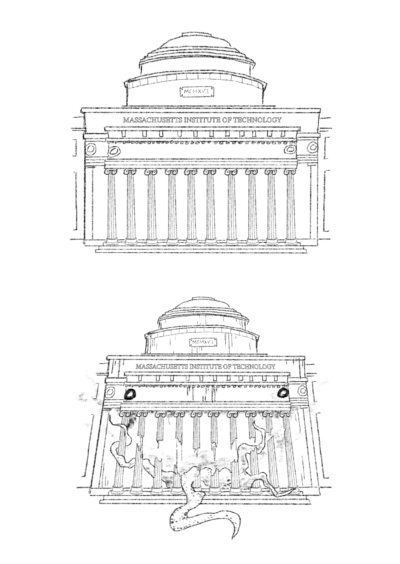
A drawing exercise from class. The prompt was to draw any building, and then an evil version of it! Pretty fitting for this blog, if you ask me.
So that’s my semester so far, in a nutshell. I’m torn between feelings of disappointment in myself, knowing I can do better, but I’m also trying to give myself grace. Truthfully, I wish I could hit rewind on the semester, but because this would violate the second law of thermodynamics, I have to move forward (and, hopefully, upwards!) I’m trying my best to stay motivated and not let this slump get the best of me. When I’m at a low point like this, I have to remind myself that there’s really no other place I’d rather be struggling academically.
- First-years have a unique grading system. During fall semester, classes are graded on a Pass/No Record basis: a passing grade of C- or above will show up as 'P' on a transcript, while a failing grade won't show up at all. During spring semester, letter grades are given for any passed classes, but the No Record policy still applies. back to text ↑
- General Institute Requirements back to text ↑
- Rush is the week after first-year orientation, when all of the frats and sororities host recruitment events for students interested in joining Greek life back to text ↑
- Multivariable Calculus back to text ↑
- Chemical Engineering/Biological-Chemical Engineering back to text ↑
- Introduction to CS and Programming using Python back to text ↑
- Electrical Engineering and Computer Science back to text ↑
- Computer Science and Molecular Biology back to text ↑
- A CI-H is a Communication-Intensive course in the Humanities, Arts, and Social Sciences. It's part of the GIRs back to text ↑
- Humanites, Arts, and Social Sciences class back to text ↑
- Non-HASS (i.e. STEM) classes back to text ↑