
church gardens by Audrey C. '24
some paintings!
I spent my IAP in northern Wales through Global Teaching Labs, a teaching abroad program! All of my weekdays were spent teaching at local schools and nights preparing last minute lessons. I’ll hopefully write a separate blog about that soon.
Thankfully, I got weekends to hop on a bus or train to the destination of my choice. While there were about a dozen other MIT students in South Wales, I was the only MIT student in North Wales. Unfortunately getting to South Wales would be 8 hours roundtrip for me, so I wandered around British streets solo. It got a bit lonely towards the end of the month. But I did appreciate getting to see things at my own pace and liking. British seagulls and pigeons fascinate me; somehow their presence seems more imposing than their American counterparts. Maybe this is just me stereotyping British entities as “posh.” Seriously though, British people eat everything with both a fork and a knife (I only noticed this after getting called out for never using my knife at dinner) and don’t tell me that’s not posh. Anyways, I scribbled the following text on a scrap piece of paper while waiting for a massively delayed train back from a day trip in Liverpool. Then I painted a few scenes while killing time in London until my flight back to Boston.
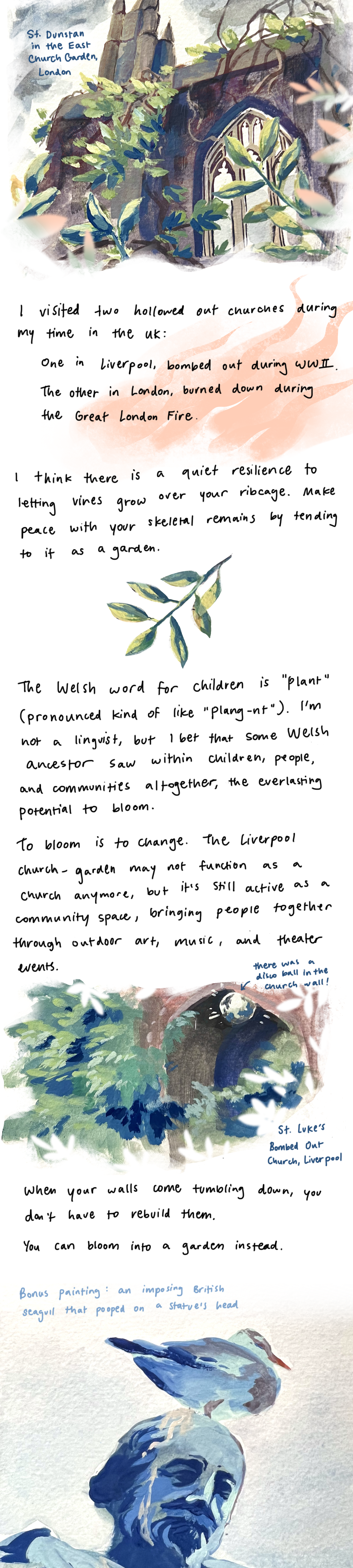
Text for accessibility:
I visited two hollowed out churches during my time in the UK:
One in Liverpool, bombed out during WWII (St. Luke’s Bombed Out Church).
The other in London, burned down during the Great London Fire (St. Dunstan in the East Church Garden).
I think there is a quiet resilience to letting vines and shrubs grow over your ribcage. Make peace with your skeletal remains by tending to it as a garden.
The Welsh word for children is “plant” (pronounced like “plang-nt”). I’m not a linguist, but I bet that some Welsh ancestor saw within children, people and communities altogether, the everlasting potential to bloom.
To bloom is to change. The Liverpool church garden may not function as a church anymore, but it’s still active as a community space, bringing people together through outdoor art, music and theater events. (there was a disco ball in the church wall!)
When your walls come tumbling down, you don’t have to rebuild them.
You can bloom into a garden instead.