
a review of my first horror movie by Joy X. '29
also THE first horror movie
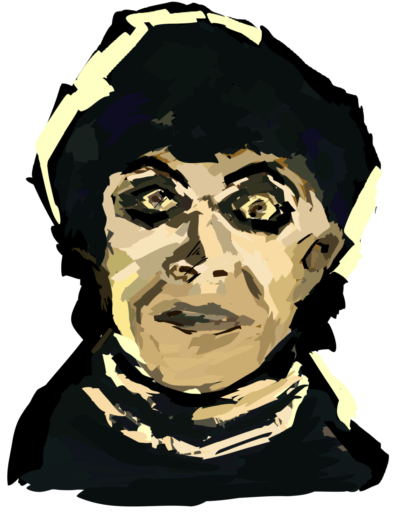
Cesare, the somnambulist.
I’ve never really been a traditional horror movie person. I don’t get the rush of adrenaline when I watch horror movies or get jumpscared—I just find it unpleasant. There is one exception: I absolutely love reading summaries of horror movies on Wikipedia; no blood, no gore, no jumpscares, no loud sounds, just pure plot and entertainment. It turns out that horror plots are kind of stupid and nonsensical without the visuals and music, especially when Wikipedia only gives you the bare bones of the plot, where scenes that are terrifying in theatres are reduced to less than a sentence. So, I’ve never really actually watched a horror movie, much less in theatres01 okay technically it was a symphony hall …until this Halloween02 shhhh i'm behind on blogging okay .
In German class, two weeks before Halloween, our professor announced that the German Department had
tickets03
MIT’s German Department is really into films, which I’m a big fan of—every fall for the past five years, they’ve hosted a German film series. I’ve only gone to one of them so far, a showing of Amrum, a story about a small village on the German island of Amrum in the last days of WWII
to a showing of Das Cabinet des Dr. Caligari, a silent horror film from 1920—with live accompaniment! Apparently it’s considered as the first psychological horror film. It sounded very interesting; I’ve never seen a film with live accompaniment before, much less the first film of its genre, so naturally, on All Hallows’ Eve, I found myself in the Boston Symphony Hall with some friends and fellow classmates from my German class. Here are my thoughts about it!
SPOILERS BELOW!
I’ll be giving some mild spoilers of the plot—if you want to experience the full 75 minutes of it for yourself, you can actually watch it on Wikipedia (wow, full circle–you can watch it on Wikipedia now! I love public domain :))
Music: 5.0/5 
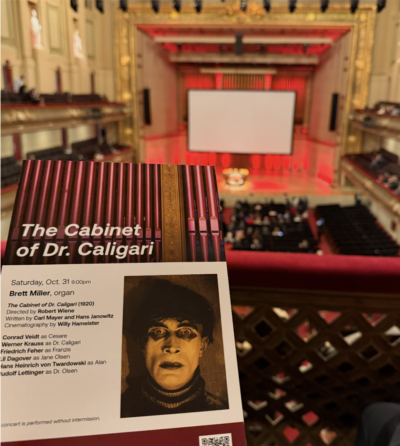
The music. Oh my god, the music was majestic. I mentioned earlier that the film had live accompaniment. I wasn’t sure what the accompaniment would be before I stepped into the Symphony Hall—would it be an orchestra? A pianist? I was absolutely delighted when I found a seat on the balcony and found myself facing a stage with a singular organ—I love the sound the organ; it’s probably my favorite instrument sound.
The acoustics in Symphony Hall were very good, and every dramatic scene was accompanied by a buildup and a dramatic BWWWUUUMMGGG04 how do I represent the sound of an organ in text…the question of the ages of the organ. The sound was absolutely majestic.
It was also very impressive to me that the organist could play for the entire 75 minute duration of the film without a conductor or (presumeably) being able to see the movie—it seemed like a long time to play, not to mention any mistakes in timing would lead to the cues being off for the entire rest of the film. Professional musicians amaze me. I could never.
Plot: 3.5/5 
The story begins in a garden, with a young man, Franzis, telling a tale of his strange experience some years past to an unnamed old man. A town fair full of oddities, a doctor by the name of Dr. Caligari, and his exhibition—a mysterious sleepwalker named Cesare, who has been sleeping for twenty three years without break…
The night that Dr. Caligari arrives in the town, the town clerk is found dead, stabbed with a strange object in the night. The next night, Franzis and his friend, Alan, visit the Doctor’s attraction, where he unveils a cabinet with the sleeping
somnambulist05
a synonym for sleepwalker
a thin uncannily-proportioned man, eerily standing within.
The Doctor claims to his spectacle observers that Cesare knows all that has happened in the past, and can see into the future. He awakens Cesare, and urges his spectators to test him for themselves.
Curious, Alan asks Cesare. “How long will I live?”
He receives his reply: “Until the break of dawn…” Gasps of horror.
The next day, he is found dead. Stabbed in the side with a sharp object.
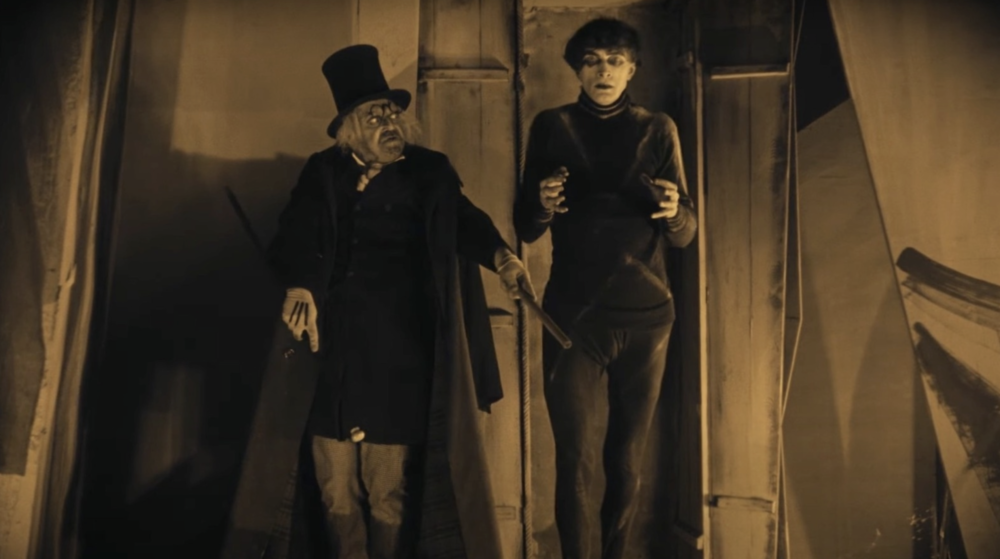
there it is, the titular cabinet!
There is of course more to the plot than this—I’ve left out most of the details in the second half of the film, which includes a kidnapping of a girl (by Cesare, the somnambulist) that both Alan and Franzis fancies, an asylum, and a twist in the last minutes. I’ll leave it to you to either find out about the plot by watching it or reading the Wikipedia summary :P
I was surprised at the plot twist—I was anticipating it, because at the beginning of the film, the organist spoke a few words, some of those words to the effect of “this is also a film where you can’t trust the narrator.” Hmmm…
I expected the plot twist to be [spoilers]06 A girl, Jane, was introduced before Alan’s murder, whom Alan and Franzis both loved. Before Alan’s death, Franzis and Alan had a whole conversation where Franzis told Alan something like “okay, let’s not stop being friends just because we love the same girl. We’ll let her decide”. Well, after Alan’s death, she has no choice. Up until the last five minutes of the film, I suspected that it would be revealed that Franzis killed his own friend and made up the story about the sleepwalker. but the actual plot twist turned out to be [spoilers]07 the entire time, Franzis was a patient in a mental asylum. This was implied in a way that confused me because I wasn’t expecting it, and had to Wikipedia it afterwards to realize what it was hinting at .
Overall, I found the plot to be interesting—I like the concept of a sleepwalker, and it was at times very suspenseful. I felt that it was a bit predictable and felt cliche at times, but I suppose it’s silly to blame a film that is the first of its genre to be predictable—after all, everything cliche is based off of it.
Scariness: 2.0/5

So a movie can’t naturally be very scary when, being a silent movie from that era, all the characters walk at 1.5x speed. At the climax of the movie, the film literally jumps a few frames, to a slightly humorous effect.
It definitely had a more disturbing than outright scary atmosphere. In particular, the set design was very distinctive—angular and somewhat claustrophobic, it looked almost cartoonish, more like something out of a Dr. Seuss story. I’m not a film analysis expert, but combined with the black and white coloring and occasional vignettes, I can say that it made for a very unique visual appearance and atmosphere.


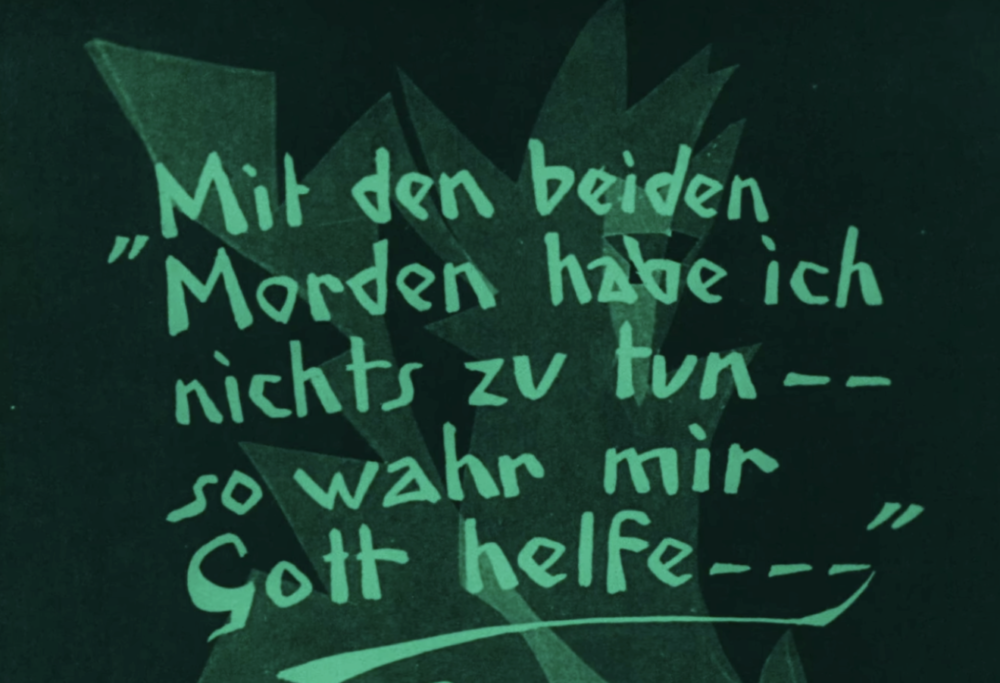
there was also this angular text that popped up between frames (as it was a silent movie, the dialogue appeared on the screen as text). the text says, “I had nothing to do with both the murders, so God help me” (there was another man accused of the murders that Cesare committed)
Also, the actor that played Cesare fit the role so well. His facial expressions were so creepy, and his lanky proportions were so uncanny. I wished there were more closeups of him, but the two closeup shots of him felt like he was staring into my soul.
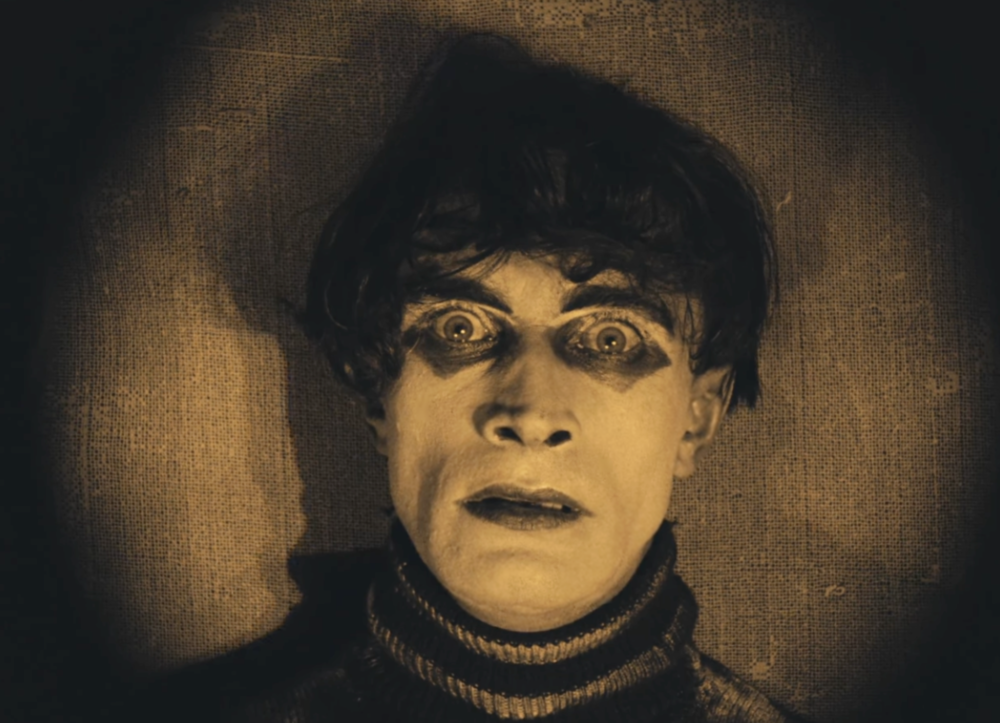
this is the scene that my drawing of Cesare is based off of
Overall, I enjoyed the film! The atmosphere was spooky and great—not just the film, but the atmosphere in Symphony Hall was great too. The Hall was packed, and there were essentially three types of people there: old people dressed very fancily, as if they were going to an opera; random college students (us); and people dressed up in all sorts of different costumes, since it was Halloween, after all. I saw one woman posing in the hallway in a very good Cesare costume.
I loved that the film was in German—it gave me the opportunity to practice my German reading comprehension, though of course there were also English subtitles. I learned a lot of German words that day, but mostly words that had to do with murder and sharp objects.
I think it’s also my first time watching a movie this old—it’s crazy to think that this movie was released over a century earlier. After some poking around on Wikipedia, I found that most of these actors were born in the 19th century, and some died before WWII began. Their surviving descendents are likely around four generations down now. This film might even be the only footage of some of the lesser known background actors.
I’m glad that these films are still being played, and that we can still see, through the medium of film, through windows into the wholly different artistic styles of a world long in the past.
- okay technically it was a symphony hall back to text ↑
- shhhh i'm behind on blogging okay back to text ↑
- MIT’s German Department is really into films, which I’m a big fan of—every fall for the past five years, they’ve hosted a German film series. I’ve only gone to one of them so far, a showing of Amrum, a story about a small village on the German island of Amrum in the last days of WWII back to text ↑
- how do I represent the sound of an organ in text…the question of the ages back to text ↑
- a synonym for sleepwalker back to text ↑
- A girl, Jane, was introduced before Alan’s murder, whom Alan and Franzis both loved. Before Alan’s death, Franzis and Alan had a whole conversation where Franzis told Alan something like “okay, let’s not stop being friends just because we love the same girl. We’ll let her decide”. Well, after Alan’s death, she has no choice. Up until the last five minutes of the film, I suspected that it would be revealed that Franzis killed his own friend and made up the story about the sleepwalker. back to text ↑
- the entire time, Franzis was a patient in a mental asylum. This was implied in a way that confused me because I wasn’t expecting it, and had to Wikipedia it afterwards to realize what it was hinting at back to text ↑