
What I Learned This Week by Aiden H. '28
notes and lessons from new classes
🦖 RAAAAAAAAAAAAAAAA!!! 🦖
And we’re back, coming in blazing with a fire and a vengeance! And a whopping three (3) weeks into the semester, everyone is ~already a little burnt out!!~
Classes this semester are:
- Harder! 🏋️
- Faster! 💨
- Longer! 🕙
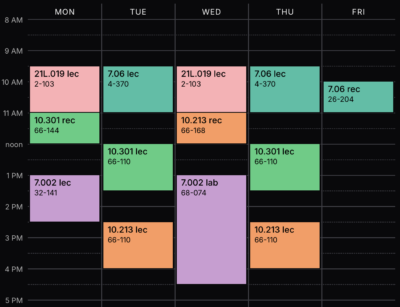
I’m in more advanced classes that are going through content at a completely unheard-of pace. All of my classes only meet twice a week for 1.5 hours, which is new for me since my previous classes met three times a week for 1 hour. This is a double-edged sword. It means that I don’t have anything but a morning recitation on Friday (🎉🎉🎉), but then I have to give my full attention for 1.5 hours, which is much much much harder than you’d think (😭😭😭).
My schedule is as follows:
7.06 – Cell Biology
This is the last class I have to take in the core bio track ( 7.01,01 Gen Bio, a GIR (required class for all MIT students) 7.03,02 Genetics 7.05,03 Biochemistry 7.06) before I can move on to upper-level bio electives!
So far, the class hasn’t been too crazy but verrrry dense. Like most pure bio classes, psets and exams are experimental/lab based, so I have to learn how to run and analyze a bunch of different assays to prove different biological phenomena, instead of just regurgitating facts that have already been proven about biology.
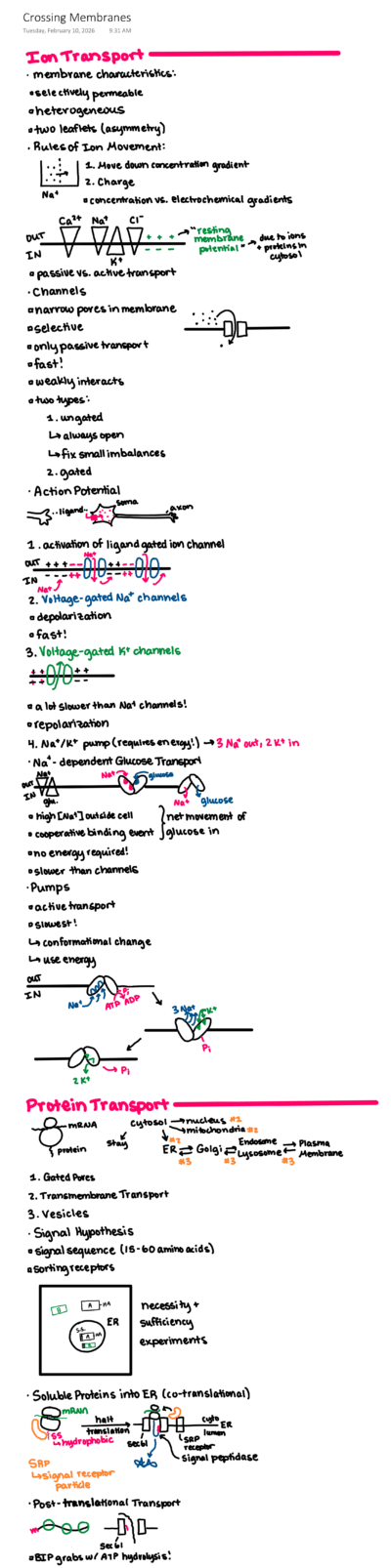
I feel like for each lecture in the class, it starts out really easy for the first hour, and then there’s a bunch of really hard new stuff thrown in at the last minute. You can see this visibly happen in my notes when things get messy and there are less written notes as I’m speed copying the diagrams on the board.
This first main unit has started with membranes and intracellular transport. Some of it serves as review from high school, but the assays and analysis go much deeper:

10.213 – Chemical and Biological Engineering Thermodynamics (aka thermo 2 for ChemEs)
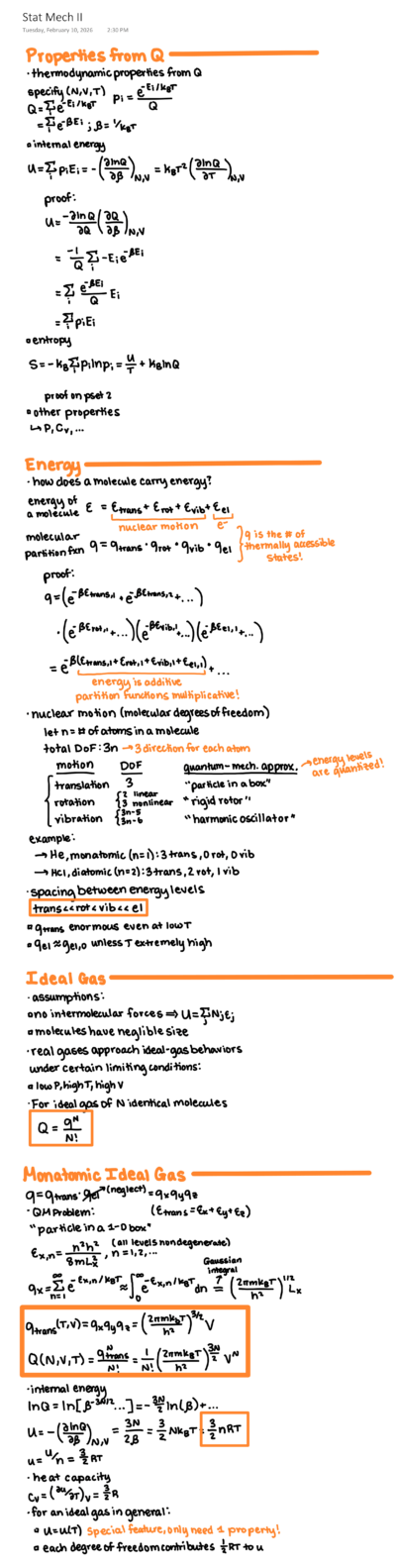
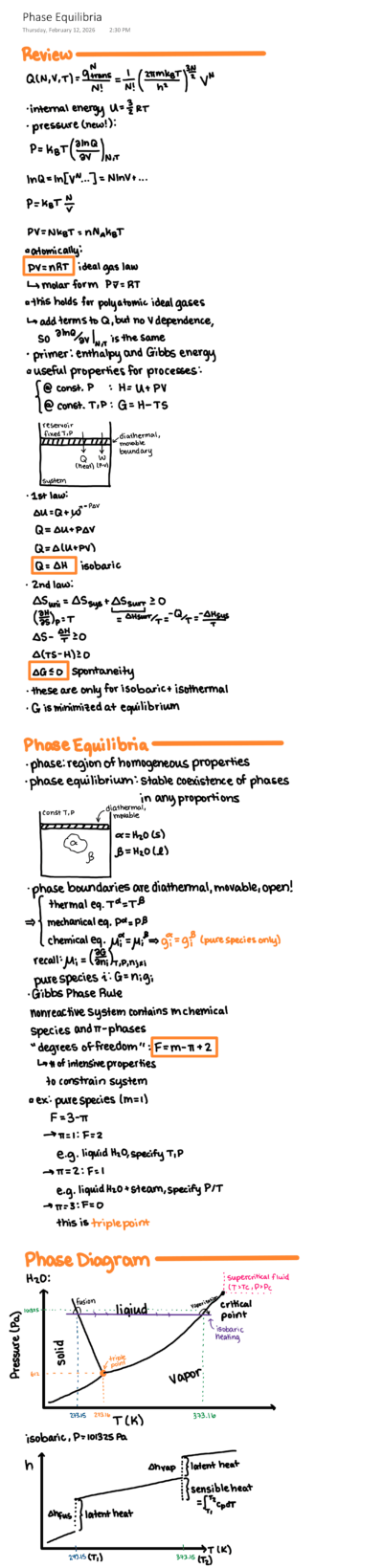
This is my second thermo class, and so far it’s just been a bunch of review from where 5.60104 Thermodynamics 1, as taught by the chem department left off last semester. The notes are pretty dense because it’s a speed review of an entire unit, but thankfully I’ve seen most of it before so it’s nothing too jarring (despite being kinda difficult).
As I’ve said before, I’m not super interested in thermo, but I also don’t find it that hard, so I’m assuming this class will be just okay. The professors are super well beloved and lectures have a good vibe, so maybe I’ll find a new appreciation for thermo??
10.301 – Fluid Mechanics
AAAA! This class is scary for many many reasons:
- It just sounds hard. This is like quintessential scary engineering class.
- I was very very bad at 8.01,05 Physics I: Mechanics so now I have to do it all again but harder and with water!
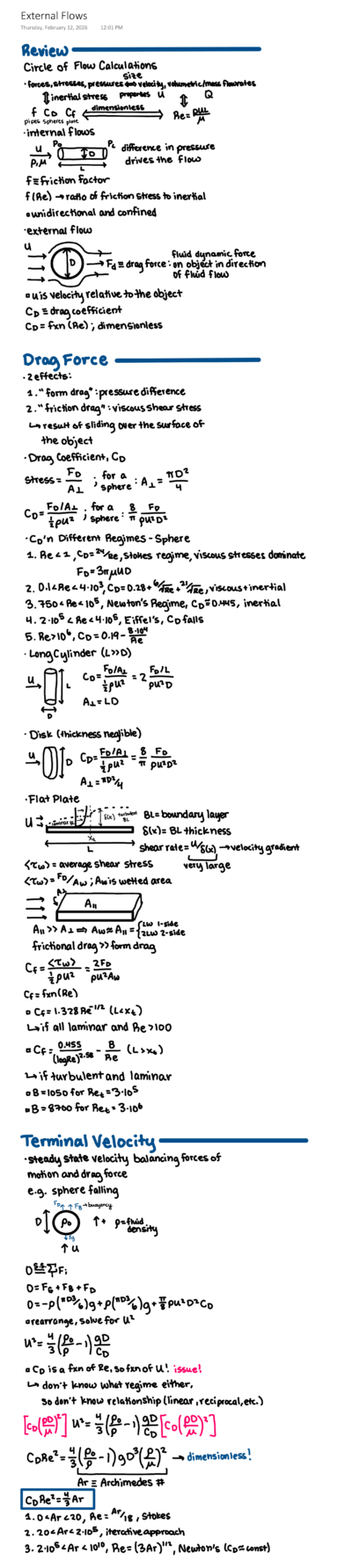
So far, so good? So far, so okay? I don’t feel that bad about the class and I can follow along in lecture, and psets don’t take ridiculous amounts of time or brain effort (even if there are some equations we have to look up in the textbook that weren’t provided in class and like wdym how was I supposed to know that the equation I needed wasn’t provided and there’s like no way to derive it because it was experimentally proven 😡😡)(I just did the pset for this week if you can’t tell).
Another thing I find frustrating but understandable is that most equations are just thrown at us without explanation because they were experimentally proven–they do run through the publications and experiments, but part of my brain just needs to watch a derivation that doesn’t exist so I can see how everything is connected.
The first week was just spent on dimensional analysis, so the following are the very first actual fluids notes I took, and also my first introduction into how to do any of this (yikes!).

21L.019 – Intro to European and Latin American Fiction
Tragically, I have to take a CI-H06 Communication Intensive in the Humanities, basically more writing than in a non-CI-H class this semester. Fortunately, it’s a lit class!
The class requires reading about 150 pages a week, either as a compilation of short stories or an entire novella. Coming into class we just have to have the story understood and a discussion question posted, and then we discuss for an hour and a half and tie it back to whatever era of Spain/Spanish colonies we’re talking about.
Last week we finished reading Lazarillo de Tormes (anonymously written) and The Dialogue of the Dogs by Miguel de Cervantes. For this next week I have to start reading Candide by Voltaire.
7.002 – Fundamentals of Experimental Molecular Biology (aka bio lab)
This is the first of two lab classes I’ll have to take, and the easier one. It consists of weekly faculty discussions/research presentations and then a 3.5 hour lab on Wednesday. The labs form a consecutive research project while teaching basic bio techniques (pipetting, gel electrophoresis, plating, vectors, etc.).
It’s…..not fun. Being timed to do manual, menial tasks is both boring and stressful, and I’m not necessarily “learning” anything. I 100000% believe this class to be necessary for any practicing biologist or biology-adjacent majors, but that doesn’t mean it *sparks joy.*
ML UROP
This is the same UROP I started IAP freshman year, and it has come a ridiculously long way in a way that I am super excited about and kinda proud of.
I’m writing my first paper and I’m first authoring it, which means I have absolutely no idea what I’m doing. It’s taking a lot longer than anticipated for me to make progress through the paper, but this week I started the methodology section and am learning how to compile figures in Overleaf/LaTeX.
Vaccine UROP
I started a new UROP at the Broad Institute! Since my other one is wrapping up/entirely dependent on me just writing the paper and not doing a lot of actual “work”, I decided to switch gears into something completely different and try wet lab research. I know part of this project is confidential because it’s externally funded, but I’m pretty sure I can share that it’s related to ~vaccine development~.
I’ve always been interested in immunology more than any other field(?) so I’m liking doing the lit review and just learning what everything is, considering I haven’t taken 7.2807 Immunology yet.
I had my first day on Friday, where we dissected mice and ran flow cytometry on some of their cells. It was a lot of shadowing and basic lab procedures I’ll need, but I’m hoping that once I get into the thick of it and can work more solo that I’ll find enjoyment in the hands-on-ness of bio work that I’ve never tried.
Welp, I have to go do a 10.213 pset because it’s due in t-42 hours and I have other stuff to do before then.
- Gen Bio, a GIR (required class for all MIT students) back to text ↑
- Genetics back to text ↑
- Biochemistry back to text ↑
- Thermodynamics 1, as taught by the chem department back to text ↑
- Physics I: Mechanics back to text ↑
- Communication Intensive in the Humanities, basically more writing than in a non-CI-H class back to text ↑
- Immunology back to text ↑