
Hacking by Snively '11
A performance art that lets students remind the teachers who's smarter.
If you’ve never seen “Hackers” then you’re depriving yourself and should make a point of getting on that train.* I get asked about hacking at MIT a lot, which is natural; I talk about it in my biography after all. There are times when I get asked, out of the blue, what made me decide to be Course 6 (Electrical Engineering and Computer Science). This confuses me because I’m actually Course 2 (Mechanical Engineering). After explaining this I then get asked “So why does your biography say that you came to MIT for the hacks?”
*Yes, I’m on a train again, and will probably include a train reference every time I write an entry from a train. I will also mercilessly steal blog formatting and style ideas from my friend Truman‘s blog.
A-ha! Hacking at MIT! There have been a bunch of entries that reference individual hacks here, and one or two that have talked more about hacking itself than individual hacks. I’d like to write one of those entries, an entry that explains what hacking is and what experiences you may have at MIT that involve hacks. And so with that, a quick primer on hacking at MIT.
Hacking at MIT has nothing to do with breaking into computer networks or computers. Instead hacking at MIT involves anonymous, ninja-like MIT students pulling off incredible feats of engineering right under the nose of the administration while quite possibly breaking dozens of laws and ending up on various rooftops around campus. Hacks could be considered “pranks” at any other school but since MIT makes up its own words and meanings for things they are called “hacks” here. People who pull them are called “hackers.”
Inevitable question one: Are you a hacker Snively!?
Well thought out answer: No, I prefer to take an observatory role. Let other people risk life and limb crawling on edges of buildings, I just want to see the end result. That, and I’d prefer to not be arrested while at MIT
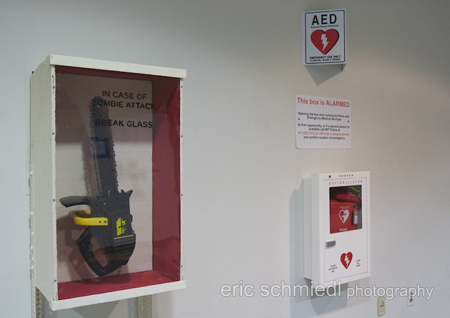
If and when you are accepted to MIT there may be a day when you’re walking through campus and you see something a little out of the ordinary. Sometimes it’s small, a chainsaw in a wooden case, sitting
in a hallway.
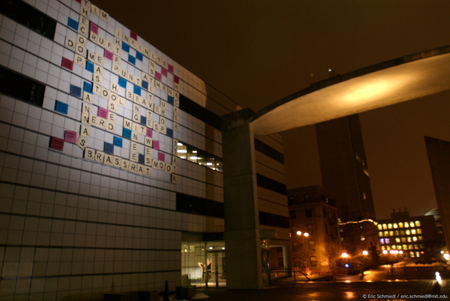
Other times it might be big, like a huge Scrabble board on the side of a building.
Sometimes it may be huge, spanning over a quarter mile!

(while hard to see, there’s a banner that says “Go Sox” suspended from a line of rope that stretches from the tower on the left to the tower on the right, over a 1000 feet)
These are all examples of hacks that have happened at MIT. In a nut shell, a hack is an addition to the school that makes somebody smile, makes them wonder how in the world this was possible, or both. The chainsaw hack is an excellent example of the smiling variety, GoSox! a good example of the “how did they do that!?” while Media Lab Scrabble is a good example of both.
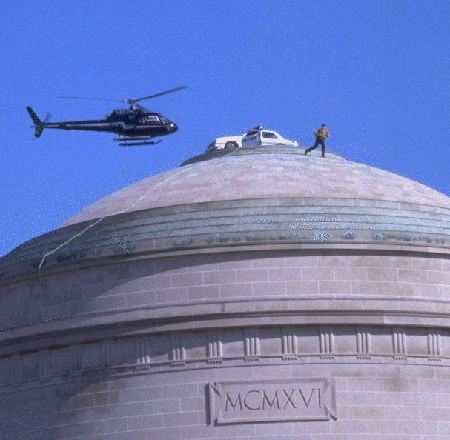
Hacks started many years ago with some crazy Senior House people dragging a car up onto their roof using a rope and a lot of manpower. After that students realized that they could put more crap on roofs, including a cow (fake cow! fake cow!) … and then things got interesting. There’s a lot of history here you can read up on at the MIT Hack Gallery but I’m going to skip to the good part. The milestone in MIT hacking that kicked it into overtime was when one day an MIT Campus Police car showed up on top of the Great Dome.
Inevitable question two: Wha- how!?
Well thought out answer: Well that’s the point now, isn’t it?
Nobody knows how they got the police car on the dome, all they knew is that perched 150+ feet above everybody’s heads was a police car, lights flashing, with a dummy cop inside holding a donut. MIT Facilities stared at it in awe, not quite sure what to think. How, erm, how were they supposed to get a car off the dome? Helicopters flew by all day, getting some great pictures, and eventually the rappelling gear was brought out and the police car was carefully disassembled on top of the dome and removed in pieces. It was saved and is now on display in the Stata center if you’re interested in seeing it.
After the police car other stuff started appearing on the dome: a working phone booth, giant beanie, triforce, and a ton of other things. Hackers realized that there was more than just the dome, that awesome hacks could fit in any number of places around campus. MIT is blessed with buildings that kind of look like the aftermath of a game of “Perfection.” We have two domes, a square courtyard, weird statues, a 3-4-5 triangle building, Kresge, the Green Building, and that pile of architectural vomit known as the Stata (rhymes with “data”) Center. Hackers have played to the strengths of the unique physical attributes of each building, transforming them into ships, R2D2, and spaceship landing sites.
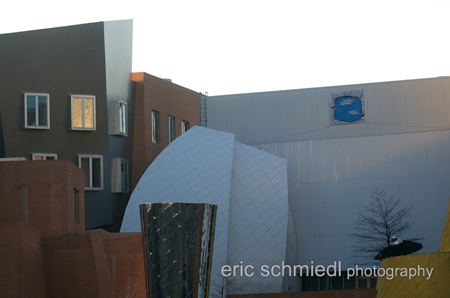
Hacks generally appear overnight since actually putting a hack up involves mucho illegality. Sure, MIT loves the aftermath of the hack, postering the admissions site and the MIT homepage with them whenever they happen, but MIT HATES hackers when they’re actually putting up a hack. Hackers have been dealt fines, had guns pulled on them, and even taken to court and threatened with jail time for hacking. More incentive for me to just enjoy looking at the fire truck on top of the dome.
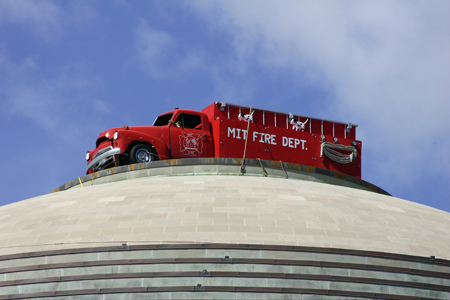
Inevitable question three: This sounds awesome! I want to run from the cops! How do I get into hacking!? Is it a club or something?
Well thought out answer: Hacking is not a club and you will never see it listed in any official activities pamphlets given to you at CPW, orientation, or anywhere else. The reason for this is because most of the things that hackers have to do in order to pull hacks are illegal and fairly dangerous. MIT doesn’t really like it when students break the law. How to become a hacker is left as an exercise for the interested reader.
Inevitable question four: How do hackers have time for all of this!?
Well thought out answer: Like any “extracurricular activity,” MIT students make time. We don’t always just lock ourselves in rooms to study, we do other stuff. Some people choose hacking.
As I’ve mentioned, hacks had a lot to do with why I wanted to come to MIT. They made me realize that MIT is, in a word, awesome. Not only are the opportunities here endless, the education first rate, but the amount of fun students had and the creativity that blankets the entire school is just phenomenal.
I think I’ll finish this post off like a class syllabus, just because I can.
Required Reading:
1) MIT Hack Gallery – http://hacks.mit.edu
Supplemental Reading:
1) Nightwork — Buy from Amazon.com
Photos courtesy of the MIT hack gallery.
First!!!!!!!!!!!!!
Great post. Hacks are one of the reasons I chose to stick with MIT
Hackers is so terrible it’s awesome.
MIT hackers, on the other hand, are simply awesome.
Probably one of your best posts ever
I loved the hack with the danger/hazard signs.
Does be the 1st to comment on every single MIT admission blog post get one into MIT?
=P
Stata is probably the most fabulous building that I’ve ever seen.
HACKS HACKS HACKS HACKS. AHHHHH.
For future reference to all the prefrosh here, breaking into computer systems is NOT hacking. That’s called cracking. Hacking (with computers, not these hacks) is just computer programming and the like. But the media screws things up =D.
And yeah, hacking was pretty much the reason I fell in love with MIT =).
Have there been people/hackers arrested before?
Well really curious, well hacks are not supposed to hurt any one(sentiments,etc ) right? But if i get washable paint, degradable(won’t cause harm) and paint the DOME pink (if you don’t like it any other color)((you might also ask how in the world can you do that without anyone noticing, well one can use a r/c helicopter and arm it with a small paint gun.. many other ways)).And the weather forecast goes wrong and it doesn’t rain for a week (pink dome ewww). And obviously the dome remains pink for a week, or worse it gets permanent, will the authorities like kick me out? being an international, they can send me back? You must have understood what I mean to ask, how and who do you ask about the safety and post hack consequences?
“One who breaks a thing to find out what it is has left the path of reason(wisdom)”
Also said by Gandalf to Saruman in the midst of their conversation in Orthanc!
Interesting post.
I find it really hypocritical of the administration to glorify the tradition of hacking while threatening students who get caught with substantial punishments. Their promotion of the hacking conveys a fun, playful atmosphere at MIT, when in reality the very act they’re using to promote it can carry serious consequences.
Either way, when I was at CPW, I noticed that the lights on the dome were on. Have they always been on? It seems like it’d be impossible to do any kind of hack with those massive lights shining up at the dome all night. I mean, it looks pretty, but are they also trying to prevent hacks on the Great Dome?
@Will ’12
The lights are a relatively new addition to the Great Dome. They are LEDs and are low energy, a green solution to the old lights that were shut off due to power consumption. The new lights were a donation from an alum, not an attempt by the administration to stop hacking.
Perhaps coincidentally, there hasn’t been a hack on the Great Dome since the installation of the lights.
@Will: You aren’t the first person to draw that conclusion. On the one hand, running around on roofs and whatnot is not only risky but definitely illegal – so if you get caught, MIT feels within its rights to slap you with a fine or some other punishment. And most students would, I think, agree that it is not out of line for MIT to (internally) discipline hackers who get caught.
On the other hand, every now and then, administrators end up handing down punishments that pretty much the entire student body finds excessive. This is part of why hacking is a perennial issue of concern for students, especially those in student government. Jessie, for example, was the key player in the discussions about roof fines that occurred a few years ago. Likewise, a number of students have been involved in the recent decision to add a section about hacking to the official student handbook.
I’d love to say more about the complicated but important interactions that occur between students and administrators regarding hacking…but this is Snively’s post after all, so I’ll save those comments for another entry.
Oh, I nearly forgot. Snively is completely correct that no hacks have appeared on the Great Dome, itself, since the installation of the lights. The lights have been hacked, though.
@if i…?
Sorry, that’s probably something I should have mentioned. There’s a hacker’s code of ethics that’s fairly well publicized. It’s as follows:
1. Be safe. Your safety, the safety of your fellow hackers, and the safety of anyone you hack should never be compromised.
2. Be subtle. Leave no evidence that you were ever there.
3. Leave things as you found them (or better).
4. If you find something broken call F-IXIT (the local number for reporting problems with the buildings and grounds). Hackers often go places that Institute workers do not frequent regularly and may see problems before anyone else.
5. Leave no damage.
6. Do not steal anything.
7. Brute force is the last resort of the incompetent. (“One who breaks a thing to find out what it is has left the path of reason.”—Keshlam the Seer, Knight of the Random Order)
8. Do not hack while under the influence of alcohol/drugs/etc.
9. Do not drop things (off a building) without a ground crew.
10. Do not hack alone (just like swimming).
11. Above all, exercise common sense.
Usually painting actual buildings is a no no. Painting things put on buildings is happy.
@Curious
Yes, hackers have been arrested before. Go ahead and read this article:
Click!
@Zaira ’11
I really don’t think he meant a target for hackers, I’m pretty sure he meant that MIT could be a target for people with bombs.
Sir Random’s birthday candles? weren’t they on the Great Dome?
Nope, that was actually on the Little Dome.
Wow, never thought such a school full of geeky smart people would prank such things –“
@Jesse – I think a school full of geeky smart people is EXACTLY the place where these things would happen =D.
While I was giving an unofficial (but legal) campus tour to my friends, we met a maintenance guy who told us that the great dome hadn’t been lit since World War II. Apparently the roof was “secured” because MIT could be a target back then.
This doesn’t make sense because hackers can get to the roof anyway, but that’s what the guy said.
“@Curious
Yes, hackers have been arrested before. Go ahead and read this article:”
Just FYI, Snively, they weren’t actually arrested. They were charged (and MIT was later pressured into making the charges go away), but never arrested. Confusing, isn’t it?
The post reminds me that I made the right college choice after all =)
hmmm, I think 66 is a 30-60-90, not a 3-4-5.
Google Earth + protractor suggests there’s a 30˚ vertex at Ames St.
Or we could always go measure the building…
This is why I LOVE MIT!!! I am so sad to have never looked at MIT culture before I was admitted… Ashamed to say I may be the only MIT’12 er to have NEVER read a blog post before decisions were released…
So0o happy I picked MIT =D And thrilled to be coming in 2 months…
WHOA snively when did you decide course 6!!?!?1