
PumpkiNerd Carving by Mitra L. '07
My dorm had a pumpkin carving contest, and categories were funniest, scariest, geekiest, most original, and best overall. Can anyone guess in which category I entered my pumpkin? (7 pictures)
As I pasted in my previous entry, my dorm had a pumpkin carving contest, and categories were funniest, scariest, geekiest, most original, and best overall.
Can anyone guess which category I entered my pumpkin in?

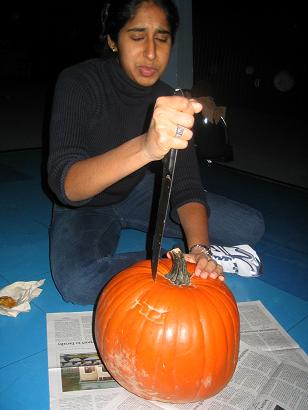
Here’s Veena ’06, who lives in Baker House. Look at the expression on her face — she obviously is a fruitarian. (I suppose “vegetabletarian” is more accurate.)
Me? Not so much.

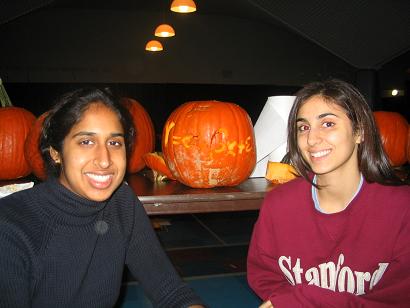
For the handful of you who are somehow not obsessed with econometrics, I should note that we carved the general form of a regression equation.

James ’08 thinks he can out-geek us by carving Athena. Right.
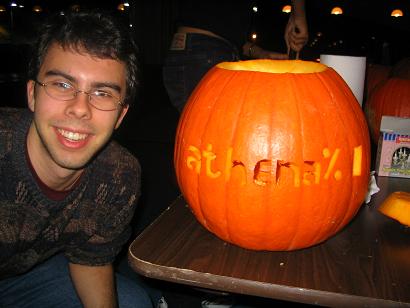
Other people noted how he not only carved in “athena%” but also included a cursor. Well, in case they didn’t notice, we not only wrote a standard equation, but even included an error term.

I think the MIT Economics Department should display this masterpiece between the 1996 and 2000 National Medals of Science.
Hi! My school also has a halloween night… except that it does not have any pumpkins! But I did like to see a similing pumpkin!
No, I think you should give it to your advisor so he doesn’t feel so bad about not having a Nobel. It’s time Samuelson and Solow were jealous of him!
Veena is fruitarian, you’re right, coz technically, the pumpkin is the fruit of the pumpkin plant.
Nice website.
If you don’t mind me asking, what did it take to get into MIT?
That’s a good question. Even if you don’t fail subjects, but just switch majors late in your MIT career, you may end up taking an extra term or two to finish.
There is an option on many MIT alumni forms for “class year you’re associated with” or something like that. That means that even if you graduated in 2050, you *really* feel like a part of 2049 and all of your friends are in that so you’re on those mailing lists and go to those reunions. “Super-senior” is a way of indicating that while you’re still a student so you don’t have to change your class number.
You guys refer to your year level as “Class of 200X”. What happens if you fail a subject (is that common at MIT?) and you can no longer finish at that year?
How many hours would the average MIT student study? How many hours would the top students study? How many hours would you study at MIT?
Is your course quite intellectually challenging compared to your perception of what the ‘average’ University would teach?
Have you heard of people who would say study from perhaps [7pm to 3am] or [4am to 7am and then again from 6pm to 10pm]?
Is the MIT Opencourseware [” rel=”nofollow”]http://ocw.mit.edu/index.html] a true representation of what you would study for economics?
Thanx for your time.
Cheers,
-PJ
What made you decide MIT Economics over say… Harvard Economics? Are the standards similar among the top schools?
I have a friend who studied engineering at Cornell, but spent a semester or two at Harvard. He said that the first 2 years at these schools are quite easy – “a joke”, and it only gets tough in the final 2 years. Is that accurate?
I heard a rumor at some point that either 1/3 or 2/3 of all MIT students fail a class at some point. Based on the people I’ve talked to, I’d say it’s probably a third. But failing one class doesn’t mean you can’t graduate on time.
In general, everyone has 17 required general classes (math, physics, bio…) and 180 units (12 units = 1 class) beyond that to graduate. So you have 8 semesters to take 34 classes. Double majors have to take 270 units beyond the 17 GIRs. Also, IAP offers a chance to take 12 units each winter, and some UROPs offer credit or pay.
In summary – failing is not the end of the world. It’s not recommended, and sucks in general, but it happens. That said, there are a number of resources available to prevent you from failing (tutoring, smart friends, study groups, office hours, etc.) and the goal is to find all those the first go around.
Oh, and four is considered the standard number of classes to take a term. 5 isn’t impossible, and some people take 7-8, but they’re regarded as insane.
I would not agree that the first two years at MIT are easy and it only gets hard for the last two. I think most people would say that it’s pretty tough all 4 years.
I don’t know if the standards are similar among similar schools — I talk to friends at different colleges, visit their campuses, and talk to professors, but unless you’re enrolled somewhere, you don’t really know what it’s like. I do think that your decision of where to go to college should combine both academic and student life issues. Yes, the school you choose should be good at what you want to study, but also you have to like the school’s environment, atmosphere, people, etc.
nice pumpkins!
That’s all pretty intense. In a setting as rigorous as MIT, I suppose failure becomes a possibility for those of us who consider ourselves the elite among our peers. Pretty humbling. But what’s with the Stanford sweatshirt?
Yes, MIT is rigorous, but keep in mind you have a semester on Pass/No Record to adjust, and you have professors, TAs, tutors, upperclassmen, and friends to help you out. There are options like Sophomore Exploratory and Junior/Senior P/D/F to encourage you to take classes you might not otherwise have taken. (I can talk more about these options if you’d like.)
The Stanford sweatshirt is because I’m from the Bay Area, and live about 20 minutes away from Palo Alto